
Narcotic Monitoring in Ontario Pharmacies: Records and Counts
Published October 1, 2026
How narcotic and controlled-substance records and reconciliation work in an Ontario pharmacy, with a worked example, common variance causes and what NarcCount does.
Narcotic monitoring in an Ontario pharmacy comes down to a few connected records: what came in, what went out, what was destroyed, and what is physically on the shelf. This page covers that pharmacy-level record keeping and reconciliation under Canadian rules. American rules do not apply to a Canadian pharmacy, so nothing here draws on them. It also does not reproduce any practice tool published by the Ontario College of Pharmacists (OCP). The College's own materials are the place to read its current wording, and this page does not stand in for them.
What Ontario sets out for records and counts
Two points from the published rules shape most of the day-to-day work. In Ontario, pharmacy patient and dispensing records, which include controlled-substance dispensing, must be kept at least 10 years (O. Reg. 264/16 s. 21). The OCP also expects narcotics and controlled substances to be reconciled at least every six months, which means at minimum twice a year. Those two points explain why a pharmacy wants records that stay readable and searchable long after the shelf count is done, and why a count is only useful when it can be compared against a running expected figure.
Perpetual inventory: a worked example
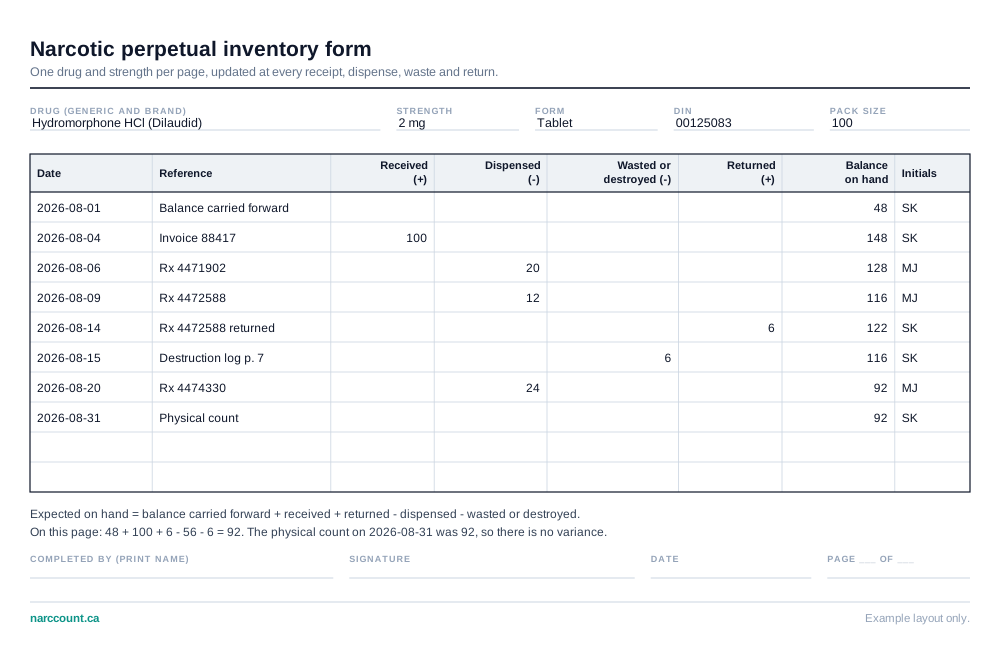
A perpetual inventory keeps an expected on-hand figure for each strength of each drug, updated as records arrive. Take one strength of a tablet. The opening balance is 600 tablets. A purchase invoice adds 200 tablets. Dispensing records for the period total 340 tablets. A documented destruction of expired stock removes 20 tablets. Expected on-hand is 600 plus 200 minus 340 minus 20, which is 440 tablets. A physical count finds 436. The variance is negative 4 tablets. That number alone is not a finding. It is the starting point for checking whether an invoice was entered at the wrong quantity, whether a dispensing record was keyed with the wrong pack size, or whether a count was taken before a late entry was posted.
Common causes of a variance
- A purchase received but not yet entered, or entered with the wrong quantity.
- A dispensing record imported twice, or a cancelled prescription still counted as dispensed.
- A partial fill recorded as a full fill, or the reverse.
- A pack size or strength mapped to the wrong drug line.
- Returned or expired stock counted on the shelf but already removed from the records.
- A count taken mid-shift while a fill was in progress.
- A transcription slip on the count sheet, such as transposed digits.
- A genuine loss or theft, which is the cause to rule out last and document most carefully.
A good entry next to a weak one
- Good: drug, strength and form are named, the quantity is stated in units, the source document is identified, and the person who made the entry is identifiable.
- Weak: a bare number with no strength, no source document and initials that cannot be traced to a person.
- Good: a correction is added as a new, dated entry that refers to the original and states the reason.
- Weak: an earlier figure is overwritten, so the history of the change is gone.
- Good: a variance is written down with the expected figure, the counted figure, the difference, and what was checked.
- Weak: a note reading 'count off, fixed' with no figures.
When a variance is not explained
Once the usual causes have been checked and a difference remains, the federal rules on loss and theft become relevant. Health Canada's Office of Controlled Substances is the body named in the published rules for reporting a loss or theft of a controlled substance. A written investigation record helps here because it shows what was compared and in what order. Whether a particular difference amounts to a loss or theft is a professional judgment that belongs to the pharmacy and its pharmacist, not to software or to this page.
What NarcCount does
NarcCount is reconciliation software sold to Canadian pharmacies. A pharmacy imports its dispensing, purchase and destruction records, and the software computes expected on-hand for each drug line. It sets that figure against the counted quantity, surfaces the variance, and keeps the supporting entries together so they can be shown when an inspector asks for them. It does not dispense anything, does not give professional advice, and does not promise any inspection outcome. For current pricing, contact NarcCount directly.
More resources
NarcCount does the reconciliation math for you and flags every variance. Get started or read the worked reconciliation example.
General information, not legal or professional advice. For authoritative requirements, refer to the Ontario College of Pharmacists and Health Canada.