
Advertising Controlled Substances: The Rules for Canadian Pharmacies
Published October 6, 2026
The Controlled Substances Regulations bar advertising controlled substances to the public, websites and social media included. What is allowed, and to whom.
Pharmacies market themselves online, and the Controlled Substances Regulations, in force since October 1, 2026, draw a clear line for any of that marketing that touches a controlled substance. A controlled substance may only be advertised to an audience that is not part of the general public, and a restricted drug may not be advertised at all (Controlled Substances Regulations s. 235). Health Canada's guidance for community pharmacies (CS-GD-022) applies that to websites and social media in so many words. This page sets out the rule, the narrow audience it permits, and the questions a pharmacy can ask before it publishes.
What counts as an advertisement
The regulation's definition is broad: an advertisement includes any representation by any means for the purpose of promoting, directly or indirectly, the sale or other disposal of a controlled substance (Controlled Substances Regulations s. 1(1)). Health Canada's guidance states that pharmacists and pharmacy technicians must not advertise or promote the sale or provision of controlled substances to the general public, and that this includes content accessible through websites, social media platforms, and digital or printed materials. For where advertising ends and other activities begin, the guidance points to Health Canada's own guidance on distinguishing advertising from other activities for health products.
The audience a written advertisement may reach
Under the Controlled Substances Regulations, a written advertisement for a controlled substance appears only in a document distributed to, or a trade publication for, the audiences below, and it carries, in a conspicuous place, a legible and intelligible statement that the substance is a controlled substance (s. 235):
- licensed dealers
- pharmacists, pharmacy technicians and practitioners
- hospitals
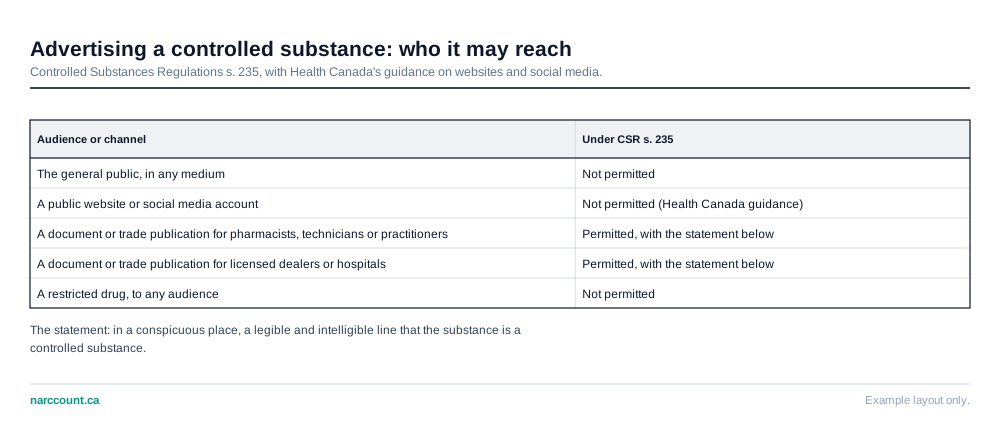
Who may see what, in one table
The table sets each audience against the rule. Health Canada's guidance treats content on a public website or social media account as reaching the general public, whoever it was written for.
Questions to ask before publishing
- Does the page, post or flyer name a narcotic, controlled drug or targeted substance, or a product that contains one?
- Does it promote, directly or indirectly, the sale or supply of that substance, for example by naming it beside a price, an offer or an invitation to come in for it?
- Can a member of the public see it, on a website, a social media account or a printed flyer?
- If it is meant for professionals, is it in a document distributed to them or a trade publication for them, and does it state that the substance is a controlled substance?
- Is the substance a restricted drug? Then it is not advertised to anyone.
Describing a service is a different question
The rule is about promoting a controlled substance. Describing a pharmacy service, such as compounding or a medication review, is not the same thing, though where a description becomes promotion depends on its wording and context. Health Canada's guidance on distinguishing advertising from other activities for health products, the provincial regulator's advertising standards and a lawyer are where a borderline case is settled. A pharmacy reviewing an existing website can start with the pages that name a drug, since those are the ones the rule reaches.
Sources
Show the 4 sourcesHide the sources
- Controlled Substances Regulations (SOR/2025-242) s. 235 — advertising — “A person that advertises a controlled substance may only do so if (a) the substance is not a restricted drug; (b) the advertisement is directed to a person that is not part of the general public; and (c) in the case of a written advertisement” it appears in a document or trade publication for the listed audiences and contains the controlled-substance statement.
- Controlled Substances Regulations (SOR/2025-242) s. 1 — definitions — “advertisement includes any representation by any means for the purpose of promoting, directly or indirectly, the sale or other disposal of a controlled substance.”
- Health Canada — Controlled substances guidance for community pharmacists and pharmacy technicians (CS-GD-022), September 29, 2026 — Page 14: “Pharmacists and pharmacy technicians must not advertise or promote the sale or provision of controlled substances to the general public. This includes content accessible through websites, social media platforms, digital or printed materials.”
- Controlled Substances Regulations (SOR/2025-242) s. 239 — in force October 1, 2026 — In full: the regulations “come into force on October 1, 2026.” The Justice Laws copy is a consolidation current to an earlier date, so it may still print “not in force” above each section.
Primary sources for the figures on this page. Regulations change; confirm the current requirement with the source before you rely on it.
More resources
NarcCount does the reconciliation math for you and flags every variance. Get started or read the worked reconciliation example.
General information, not legal or professional advice. For authoritative requirements, refer to the Ontario College of Pharmacists and Health Canada.