
Controlled Substances Regulations: Counts, Records and Loss Reporting
Published October 5, 2026
On October 1, 2026, the Controlled Substances Regulations replaced the Narcotic Control Regulations. Here is what changed for counts, records and loss reports.
On October 1, 2026, the federal Controlled Substances Regulations (SOR/2025-242) came into force. They replaced the Narcotic Control Regulations, the Benzodiazepines and Other Targeted Substances Regulations and Parts G and J of the Food and Drug Regulations, so the narcotics, controlled drugs and targeted substances a community pharmacy counts now sit under one regulation instead of three. Most of the daily work carries over; a few duties are new or newly spelled out. This page covers counts, records and loss or theft reports, with the section behind each point. It is general information, not legal advice.
What changed on October 1, 2026
Before October 1, a pharmacy worked under three federal rule books: the Narcotic Control Regulations for narcotics, the Food and Drug Regulations, Part G, for controlled drugs, and the Benzodiazepines and Other Targeted Substances Regulations for targeted substances. The categories did not change, only where the drugs are listed: narcotics, controlled drugs and targeted substances are now Schedules 1, 2 and 3 of the new regulation. Section 238 of the Controlled Substances Regulations repeals the narcotic and benzodiazepine regulations, section 237 repeals Parts G and J of the Food and Drug Regulations, and section 239 sets the start date. A pharmacy that closes also no longer sends Health Canada a notice when its controlled-substance stock is transferred.
Loss and theft: the same 10 days, now in writing
The reporting duty did not move. A pharmacist who becomes aware of a loss or theft of a controlled substance must provide a written report to the Minister, in practice Health Canada’s Office of Controlled Substances, within 10 days after the day they become aware of it (Controlled Substances Regulations s. 109(2)). The repealed rules set the same 10 days (Narcotic Control Regulations s. 42; Food and Drug Regulations s. G.03.013; Benzodiazepines and Other Targeted Substances Regulations s. 72(2)). Two things are newly spelled out. An employee or contractor who learns of a loss or theft must tell the pharmacist immediately, and the pharmacist’s 10 days then run from the day they are told (Controlled Substances Regulations s. 109(1) and (2)). And the report, or any evidence derived from it, cannot be used to incriminate the pharmacist or their staff in a criminal proceeding, apart from a few listed offences (Controlled Substances Regulations s. 109(3)).
What Health Canada now says to report
Health Canada’s new community pharmacy guidance, dated September 29, 2026, is plain about scope. Every loss or theft is reported regardless of the amount, and its own example is that “even if one pill is lost, it must be reported.” A shortage on a count that “cannot be reconciled or definitively explained” is reported as a loss or theft. It names the E-Services Portal as the preferred way to file, with the Loss or Theft Report Form by email as the alternative. The report should describe what happened, what the internal investigation found and what was done to prevent a repeat, and it should carry no patient information. Federally, a copy of the report is kept at the pharmacy for two years (Controlled Substances Regulations s. 123(1)).
The four outcomes of a count investigation
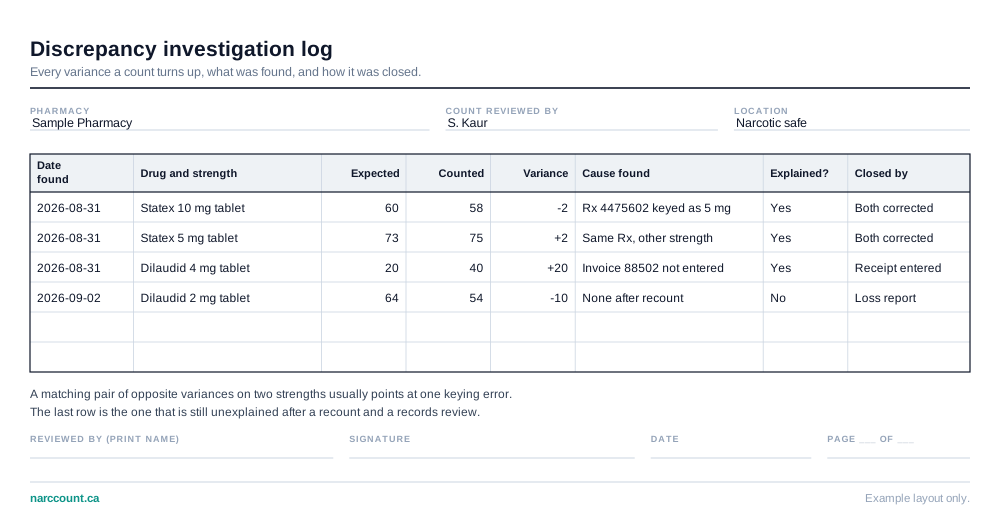
When a line on a count does not balance, the investigation ends in one of four places, and only two of them go to Health Canada.
- Theft. Always reported to Health Canada, whatever the amount. Health Canada treats internal pilferage, a break-in, a robbery and a forged prescription that was filled as thefts. In Ontario, the Ontario College of Pharmacists says thefts are also reported to the police.
- Unexplained loss. A shortage that a recount and a review of the records cannot explain is a loss, and it is reported within 10 days of becoming aware of it (Controlled Substances Regulations s. 109(2)); Health Canada dates that from when a suspected loss is first noticed, not from the end of the review. Keep investigating, because the aim is to find the reason and turn the line into a documented, explained shortage. The investigation never holds the report back: Health Canada’s guidance says it must not delay the report, and what it finds later is sent as an amendment, which can bring the quantity still missing down to zero.
- Documented miscount or explained shortage. When the cause is shown rather than assumed, the line is not a reportable loss: a recount that finds the stock, a destruction that was never entered, a dispense keyed under the wrong DIN. Keep the notes with the count. Health Canada treats a miscount that is only assumed as an unexplained loss.
- Overage. More on the shelf than the records expect is not reportable, but it is still investigated and documented, because an unexplained overage can become the next count’s shortage. Take a part-fill billed in full while the owing is still on the shelf: today it reads as extra stock, and if the record is simply adjusted up to match, the tablets that leave when the owing is picked up read as a shortage at the next count.
Records: one regulation, the same two years
Federally, the retention period is still two years, but the Controlled Substances Regulations now say when the clock starts and who answers for it (s. 123(1)). The pharmacist responsible for the pharmacy’s operations makes sure each record book or file is kept two years after its last entry, written orders and prescriptions are kept in date and number order for two years after they arrive, and every declaration and report, a loss or theft report or a destruction declaration included, is kept two years after it is made or received. The Controlled Substances Regulations also require an audit-ready recording method (s. 122), sale records kept separately in date and number order (s. 123(2)), records kept at the pharmacy (s. 124) that are complete, legible and indelible (s. 125), and records produced when the Minister asks (s. 126). A destruction is witnessed and both people sign a joint declaration immediately afterwards (Controlled Substances Regulations s. 110(1)); a patient return’s destruction record needs only the collection container’s identifier and the number of containers (Controlled Substances Regulations s. 121). In Ontario, pharmacy patient and dispensing records still have to be kept at least 10 years (O. Reg. 264/16 s. 21), the longer rule an Ontario pharmacy works to.
Counting: the regulation sets no interval
The Controlled Substances Regulations do not set a counting interval for a community pharmacy; the only physical inventory they require is the month-end inventory a licensed dealer reports. The interval comes from guidance and from your provincial college. Health Canada’s new guidance recommends a complete manual count at least twice a year, and also before and after a pharmacy move, after a non-compliant Health Canada inspection, after a change of pharmacy manager or owner or unexpected staffing changes, and after any event that compromised security, such as a break-in or suspected internal theft. It recommends that a pharmacist does the count, or someone under a pharmacist’s direct supervision, such as a pharmacy technician. In Ontario, the College’s Designated Manager policy requires a physical count and reconciliation of all controlled substances at least once every six months.
What to update now
- Replace references to the Narcotic Control Regulations in procedures, count cover sheets and loss-report templates with the Controlled Substances Regulations (SOR/2025-242).
- Tell staff in writing that anyone who notices a loss or theft tells the pharmacist immediately.
- Count the federal 10-day deadline from the day the pharmacist becomes aware of a loss, not from the day the investigation closes.
- File the loss or theft report with its count, the investigation notes and any amendment, and keep the set for at least the federal two years; in Ontario, the dispensing records behind it stay at least 10 years.
- Give every overage on the last count a written cause, not just an adjustment.
Where NarcCount fits
NarcCount works out the expected on-hand figure from the dispensing, purchase and destruction records a pharmacy imports, and shows the variance against the physical count for every line. The pharmacist records what the investigation found and which of the four outcomes applies; NarcCount does not make that call. For a line marked as a loss, it shows the federal 10-day reporting deadline, counted by default from the count date, and its loss report fills in Health Canada’s own Loss or Theft Report Form from the count for the pharmacist to check and submit. Nothing is sent to Health Canada by NarcCount.
Sources
- Controlled Substances Regulations (SOR/2025-242) s. 109 — loss or theft — Federal, verbatim: “the pharmacist must provide a written report to the Minister within 10 days after the day on which they become aware of the loss or theft or are notified.” Subsection (1) is a staff member’s duty to tell the pharmacist immediately; subsection (3) is the partial protection against self-incrimination.
- Controlled Substances Regulations s. 123 — retention, with ss. 122, 124, 125 and 126 — Federal: documents are “kept for two years after the day on which the last record is recorded in the document”, written orders and prescriptions two years after receipt, and every declaration and report two years after it is provided or received. Sections 122 and 124 to 126 cover an audit-ready method, the place, the quality of the records and producing them on request.
- Controlled Substances Regulations s. 110 — destruction in a pharmacy — Federal: destruction by a pharmacist or pharmacy technician, witnessed by another pharmacist, pharmacy technician or intern, a practitioner or any other health professional, with a joint declaration signed and dated immediately afterwards.
- Controlled Substances Regulations s. 238 — repeals — Repeals four regulations, among them the Narcotic Control Regulations and the Benzodiazepines and Other Targeted Substances Regulations.
- Controlled Substances Regulations s. 239 — in force October 1, 2026 — In full: the regulations “come into force on October 1, 2026.” The Justice Laws copy is a consolidation current to an earlier date, so it may still print “not in force” above each section.
- Canada Gazette, Part II, December 17, 2025 — the regulation as made, and its Regulatory Impact Analysis Statement — Section 237 as made: “Parts G and J of the Food and Drug Regulations are repealed.” The Justice Laws consolidation prints that section only as “[Amendments]”. The impact statement also records that a pharmacy no longer notifies Health Canada when it closes.
- Health Canada — Controlled substances guidance for community pharmacists and pharmacy technicians (CS-GD-022), September 29, 2026 — Health Canada’s guidance written for the new regulation, as distributed by the Ontario College of Pharmacists; on 5 October 2026 Health Canada’s own CS-GD-022 web page still showed the 2023 edition. The source of “even if one pill is lost, it must be reported”, of what a report should contain, and of the recommended counts.
- Health Canada — Guidance on reporting loss or theft (CS-GD-005) — “The investigation must not delay the incident reporting to Health Canada.” Findings that arrive later are sent as an amendment, and a full recovery is reported as 0 still missing.
- Health Canada — CS-GD-005 Appendix A, types of incidents — Theft and an unexplained loss are reportable. A miscount is not reportable when it is documented, and is an unexplained loss when it is only assumed. An overage is not reportable.
- Health Canada — Reporting loss or theft of controlled substances or precursors — Where a report is filed: the E-Services Portal, or the fillable Loss or Theft Report Form sent by email. “Any user can draft a report in the portal, but only an official individual can submit a report.”
- Ontario College of Pharmacists — Controlled Substances Regulations information hub — Ontario: lists the federal rules no longer in effect from October 1, 2026, including Parts G and J of the Food and Drug Regulations, and says Ontario pharmacists cannot therapeutically substitute one controlled substance for another.
- Ontario College of Pharmacists — Controlled Substances: Reporting Loss or Theft — Ontario, revised October 2026: “Thefts (e.g., robbery, break and enter, etc.) are to be reported to the police.”
- Ontario College of Pharmacists — Controlled Substances: Security and Reconciliation — Ontario, revised October 2026: the Designated Manager policy requires a physical count and reconciliation of all controlled substances at least once every six months. Explained differences “may not need to be reported to Health Canada, however internal documentation must still be retained.”
- O. Reg. 264/16 s. 21 (General, Drug and Pharmacies Regulation Act) — The 10 years runs from the last pharmacy service provided to the patient, and longer again for a patient who was a minor.
- Former (repealed October 1, 2026): Narcotic Control Regulations s. 42 — Federal, repealed: “A pharmacist shall report to the Minister any loss or theft of a narcotic within 10 days of his discovery thereof.”
- Former (repealed October 1, 2026): Food and Drug Regulations s. G.03.013 — Federal, repealed: the same 10 days, for a controlled drug.
- Former (repealed October 1, 2026): Benzodiazepines and Other Targeted Substances Regulations s. 72(2) — Federal, repealed: a written report “within 10 days after becoming aware of the occurrence” of a theft or loss of a targeted substance.
Primary sources for the figures on this page. Regulations change; confirm the current requirement with the source before you rely on it.
More resources
NarcCount does the reconciliation math for you and flags every variance. Get started or read the worked reconciliation example.
General information, not legal or professional advice. For authoritative requirements, refer to the Ontario College of Pharmacists and Health Canada.