
Narcotic Count Procedure and Policy for Canadian Pharmacies
Published November 1, 2026
How a written narcotic and controlled substance count procedure is built in a Canadian pharmacy: the sheet, a worked variance example, and common causes.
A written count policy describes how a pharmacy checks the stock of narcotics and controlled substances on its shelves against what its records say should be there. The procedure is the part that gets followed day to day: who counts, what is recorded, and what happens when the numbers disagree. This page covers the Canadian position. American rules do not apply to a Canadian pharmacy, so nothing here draws on them. Federal rules sit under the Controlled Substances Regulations, and provincial colleges add their own expectations on top. NarcCount is software that helps pharmacies keep these records. It gives no professional advice, and the pharmacy's own policy and its regulator are the authority.
What a written count policy usually contains
- The substances covered, such as narcotics, controlled drugs and targeted substances, and where each is stored.
- The role of the person who performs a count and the role of the person who reviews the result afterward.
- The form used to record a count, and where completed forms are filed.
- The point at which a difference between expected and counted stock is treated as a variance to investigate.
- How an investigation is documented and how its outcome is recorded.
- Where reporting to a college or to Health Canada fits when a variance proves to be a loss or theft.
What a controlled substance count sheet records
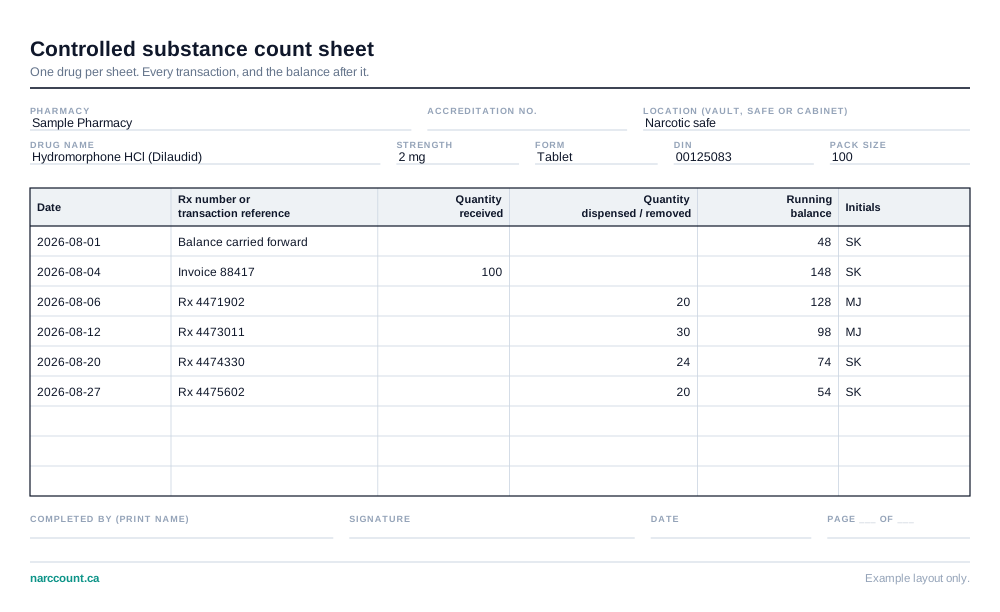
A count sheet is the working record of a single count. A complete entry names the drug, strength and form, the date and time, the expected quantity from the perpetual record, the quantity physically counted, the difference, and the initials of the person who counted. A good entry reads: Drug and strength written in full, expected 160, counted 158, difference minus 2, initialled and dated. A poor entry reads: count ok. The second version cannot be reconciled later because it holds no quantities, no date of the count and no name. An inspector reading a file months afterward can only rely on what was written down at the time, so numbers and a legible initial are what make an entry useful.
A worked example of a count and a variance
Take a 5 mg tablet in a locked cabinet. The opening balance carried from the last count is 240 tablets. A wholesaler delivery of 100 tablets is received and entered. Across the period, dispensing records show 180 tablets supplied on prescriptions. Expected on-hand is 240 plus 100 minus 180, which is 160 tablets. The counter finds 158 on the shelf. The variance is minus 2. Nothing is concluded from the number alone. The next step is to compare the dispensing entries against the prescriptions, check that the delivery was entered at the quantity actually received, and look for a unit mix-up. The finding, whether a transcription slip or an unexplained shortage, is written next to the count so the file shows how the gap was explained.
Common causes of a variance
- A dispensing quantity keyed differently from the quantity actually counted into the vial.
- A delivery entered at the quantity on the invoice rather than the quantity received.
- A returned or partly filled prescription that was never adjusted in the record.
- Tablets spilled, dropped or damaged during counting and not logged as waste.
- A transfer between locations or between a stock bottle and a working bottle that was recorded on one side only.
- Product from one strength or pack size counted into the other.
- An opening balance carried forward incorrectly from the previous count.
Reconciliation timing across provinces
Timing differs by province. In Ontario, the Ontario College of Pharmacists (OCP) expects narcotics and controlled substances to be reconciled at least every six months, which is at minimum twice a year. Alberta, British Columbia, Saskatchewan, Manitoba, and Newfoundland & Labrador generally require reconciliation every three months. In Prince Edward Island, targeted substances are reconciled at least once every six months. Separately, when a variance turns out to be a loss or theft, the federal rule is that a report goes to Health Canada's Office of Controlled Substances within 10 days after the day of becoming aware of it (Controlled Substances Regulations s. 109(2), in force October 1, 2026). A pharmacy's own policy may call for counts more often than any of these minimums.
Where NarcCount fits
NarcCount is software sold to pharmacies. A pharmacy imports its dispensing, purchase and destruction records, and the software computes expected on-hand for each product, lists the variances it finds, and keeps the supporting documentation together so it can be produced when an inspector asks. It does not dispense anything, it does not decide whether a variance is reportable, and it does not replace a pharmacy's written policy or its professional judgment.
More resources
NarcCount does the reconciliation math for you and flags every variance. Get started or read the worked reconciliation example.
General information, not legal or professional advice. For authoritative requirements, refer to the Ontario College of Pharmacists and Health Canada.