
Shift Change Narcotic Count Sheet for Canadian Pharmacies
Published October 29, 2026
A printable shift change narcotic count sheet for Canadian pharmacies, with the columns explained, a worked example and the usual causes of a variance.
A shift change narcotic count sheet records what was physically on the shelf or in the safe when one block of work ends and the next begins. Each line holds a product, the quantity the pharmacy expected, the quantity actually counted, and the difference. This page shows the sheet, explains each column, and walks through a worked example with quantities. It covers the Canadian requirement. American rules do not apply to a Canadian pharmacy, so forms and terms from other countries are left out.
The shift change count sheet
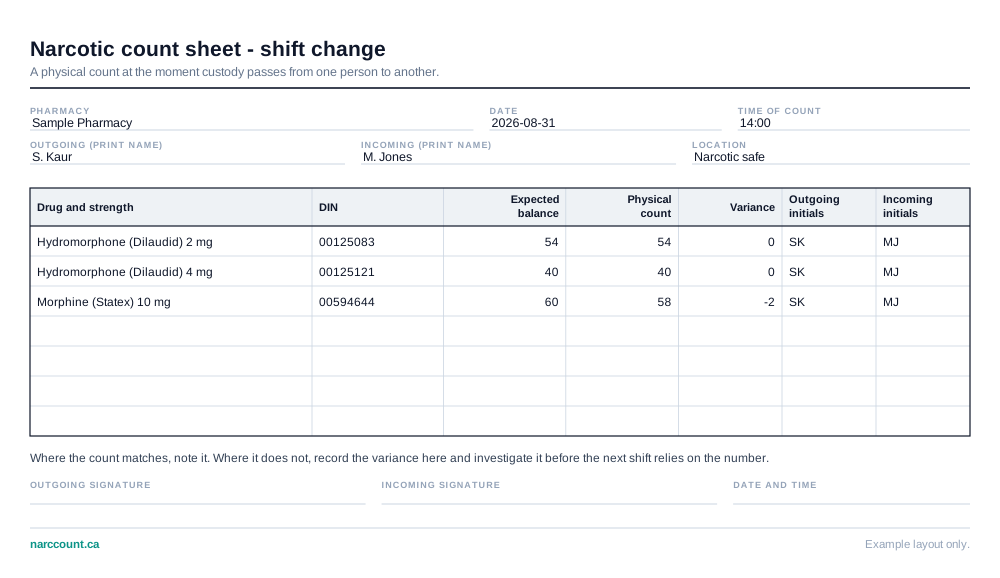
The figure on this page is a printable sheet laid out for one count. The header carries the pharmacy name, the date, the time of the count, and the name and signature of the person who performed it. Below that, one row is used for each product and strength. The columns are: product and strength, container or location, opening quantity carried from the last sheet, quantity received since then, quantity dispensed since then, expected on hand, counted on hand, variance, and a notes field. The signature line belongs to the person who counted. Printing it on letter paper in landscape keeps every column readable, and a blank copy can be kept in a binder at the counting station.
Filling it in, step by step
- Write the date and the exact time of the count in the header before touching any stock.
- Copy each opening quantity from the closing line of the previous sheet, not from memory.
- Add the quantity received since the last count, using the receiving record as the source.
- Subtract the quantity dispensed since the last count, using the dispensing records as the source.
- Write the result in the expected column, then count the stock by hand and write that figure in the counted column.
- Subtract expected from counted and write the difference with its sign, so a shortage shows as a negative number.
- Describe any variance in the notes field in plain words, then sign and date the sheet.
A worked example
Take oxycodone 5 mg tablets. The previous sheet closed at 240 tablets. Since then, 100 tablets arrived from the wholesaler and 46 tablets were dispensed across several prescriptions. Expected on hand is 240 plus 100 minus 46, which is 294. The hand count finds 292. The variance is minus 2, and the notes field records it as a shortage of 2 tablets along with the prescriptions dispensed in the period. A matching count would show a variance of 0, and a 0 is still written in the column so the line is never left blank. A blank cell on a count sheet reads later as a line that was skipped.
What a good entry looks like next to a poor one
- Good: Oxycodone 5 mg tab, opening 240, received 100, dispensed 46, expected 294, counted 292, variance -2, note naming the likely cause. Poor: a single figure with no opening, no expected and no variance.
- Good: initials or full signature, with the time of the count. Poor: a date alone, which cannot place the count between two dispensing events.
- Good: the note says what was checked, such as a pour-back, a split package or a transcription slip. Poor: the note says only 'short'.
- Good: a correction is a single line struck through, with the new figure beside it. Poor: the original figure is overwritten or erased, so the history is lost.
Common causes of a variance
Most small differences trace back to a short list of causes. A tablet dropped or miscounted during dispensing is the most frequent. Others include a prescription dispensed but not yet entered, a receipt entered against the wrong strength, a partial fill recorded as a full fill, a returned or reversed prescription that was never reversed in the records, and a transposed digit when the opening quantity was copied. Checking those first, in that order, usually resolves a variance of a few units. A difference that no record explains is treated differently. Federally, a loss or theft is reported to Health Canada's Office of Controlled Substances within 10 days after the day of becoming aware of it (Controlled Substances Regulations s. 109(2), in force October 1, 2026). Whether a given variance reaches that point is for the pharmacy's professionals to judge.
How the sheet fits with reconciliation
A shift sheet is a short-interval check, separate from the periodic reconciliation that regulators describe. In Ontario, the Ontario College of Pharmacists expects narcotics and controlled substances to be reconciled at least every six months. Frequent sheets give that larger reconciliation a trail of small, dated counts to work from, so a discrepancy can be placed in a narrow window instead of a long one. NarcCount is software that Canadian pharmacies use to import their dispensing, purchase and destruction records. It computes expected on-hand for each product, surfaces variances against a count, and keeps the supporting documentation in one place. It does not dispense anything and does not give professional advice.
More resources
NarcCount does the reconciliation math for you and flags every variance. Get started or read the worked reconciliation example.
General information, not legal or professional advice. For authoritative requirements, refer to the Ontario College of Pharmacists and Health Canada.