
How Long Does a Pharmacy Keep Records in Canada?
Published September 2, 2026
In Ontario, pharmacy records are kept at least 10 years (O. Reg. 264/16 s. 21). Federally, controlled-substance records are kept at least 2 years.
A pharmacy in Canada works under two retention rules at once: a provincial rule for patient and dispensing records, and a federal floor for narcotic, controlled drug and targeted substance records. The two periods are different, a single record is often covered by both, and the longer one decides how long that record stays on file. This guide sets out the Ontario and federal periods, which documents belong in the controlled-substance file, and how to organize storage so a retention review never throws away something that is still needed.
Two rules, and the longer one governs
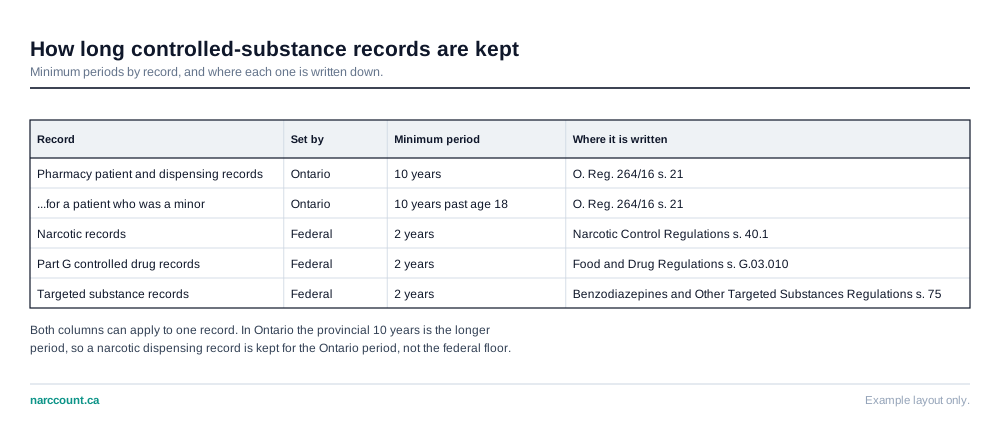
In Ontario, pharmacy patient and dispensing records, which include controlled-substance dispensing, are kept for at least 10 years (O. Reg. 264/16 s. 21). For a patient who was a minor, the Ontario period runs to at least 10 years past the day they turn 18. Federally, the floor is at least 2 years, and each drug class has its own provision: narcotics under Narcotic Control Regulations s. 40.1, Part G controlled drugs under Food and Drug Regulations s. G.03.010, and targeted substances such as benzodiazepines under Benzodiazepines and Other Targeted Substances Regulations s. 75. A narcotic prescription dispensed in Ontario sits under both rules, so in practice it follows the Ontario period. A pharmacy in another province checks its own college's retention rule, since this guide states only the Ontario and federal figures.
What belongs in the controlled-substance file
Retention questions usually come up about prescriptions, but an inspector reviewing a narcotic variance will ask for everything that fed the expected on-hand figure. A complete file for each period typically holds:
- Supplier invoices and packing slips for every receipt, with the date the stock was actually received and who checked it in
- Prescriptions and the dispensing records generated from them, including part fills and reversed claims
- Destruction records, with the quantity, the drug and strength, and the names of the person destroying and the witness
- Records of patient returns, kept separate from stock and never added back to inventory
- Returns or transfers to a supplier or another pharmacy
- Every physical count sheet and the signed reconciliation that compared it to the expected balance
- Investigation notes for each variance, including the cause found and the corrective entry
- Copies of any loss or theft report and related correspondence
- For methadone or other liquids, pump calibration and daily balance logs
When the period starts
For Ontario patient records, the period is measured from the last pharmacy service provided to that patient, so a long-term patient's older prescriptions stay tied to the most recent visit rather than to their own dates. Inventory documents such as count sheets and invoices are simpler to handle as a batch. A common approach is to label each box, binder or electronic folder with the latest date it contains, because that is the date a retention review works from. A binder that holds counts from January through to a final count in December is judged by the December date, not the January one.
Paper, scanned, or electronic
Records can be kept on paper or electronically, as long as they stay complete, legible and retrievable when an inspector asks. Scanning is where quality usually slips. A good scan captures both sides of each page, keeps signatures and handwritten initials readable, and is filed so a single drug and period can be found without opening every file. Electronic records work best with an audit trail showing who entered or changed a value and when. Before any paper original is disposed of in favour of a scan, many pharmacies confirm with their college that the scanned copy is acceptable as the record.
Running a retention review safely
Most record loss comes from a clean-out done in a hurry. A steady, documented review avoids it:
- List every storage location first: the dispensary, the back office, off-site storage, shared drives and any retired pharmacy software
- Read the latest date on each box or folder and compare it against the longest period that applies to anything inside
- Set aside anything connected to an open investigation, a loss or theft report, an insurer query or an inspection finding, whatever its age
- Keep destruction witness sheets and invoices with the counts they explain, not in a separate accounting archive
- Record what was reviewed, what was kept, what was disposed of, and who signed off, and keep that review log with the records
Where records go missing in practice
The documents most often absent during an inspection are not prescriptions. They are invoices filed by the head office or the bookkeeper instead of the pharmacy, destruction sheets kept in a binder nobody associates with the narcotic file, count spreadsheets overwritten by the next count, and history that did not survive a change of dispensing software. Exporting a complete controlled-substance history before a software conversion, and saving each count as a dated, unchangeable copy, closes most of those gaps.
Keeping reconciliation records with NarcCount
NarcCount imports dispensing, purchase and destruction records and keeps a dated record of every reconciliation, including the expected balance, the physical count and any variance notes. Because each period's documentation is stored together, pulling the history behind one drug for a retention review or an inspection takes minutes rather than a day spent going through binders.
Sources
- O. Reg. 264/16 s. 21 (General, Drug and Pharmacies Regulation Act) — The 10 years runs from the last pharmacy service provided to the patient, and longer again for a patient who was a minor.
- Narcotic Control Regulations s. 40.1 (narcotics) — Federal, and verbatim: “at least two years any records which they are required to keep by these Regulations” — these Regulations, meaning narcotic records only, which is why the other two below are also needed.
- Food and Drug Regulations s. G.03.010 (Part G controlled drugs) — The near-identical federal two-year rule for records a pharmacist keeps under Part G.
- Benzodiazepines and Other Targeted Substances Regulations s. 75 — Federal: two years for documents recorded under those Regulations, which is what covers benzodiazepines and the other targeted substances.
Primary sources for the figures on this page. Regulations change; confirm the current requirement with the source before you rely on it.
More resources
NarcCount does the reconciliation math for you and flags every variance. Get started or read the worked reconciliation example.
General information, not legal or professional advice. For authoritative requirements, refer to the Ontario College of Pharmacists and Health Canada.