
Low-Dose Codeine Products in Canada: The Pharmacy Rules
Published October 6, 2026
A pharmacist can sell low-dose codeine without a prescription under set conditions. Its receipt is still recorded and its inventory still tracked.
Low-dose codeine products, the combination tablets and syrups a pharmacist can sell without a prescription, are controlled substances under the Controlled Substances Regulations, in force since October 1, 2026, with one exception carved out for the sale itself. That exception is narrow: it covers a defined product, sold by a pharmacist, under specific conditions (Controlled Substances Regulations s. 98(2)). Everything around the sale still applies. The product is ordered and received like any other controlled substance, its receipt is recorded, and Health Canada's guidance for community pharmacies (CS-GD-022) says pharmacists should still track its inventory. This page sets out the conditions and the records, and explains why these products are a frequent source of count variances.
What counts as a low-dose codeine product
A finished product qualifies only if every one of these is true:
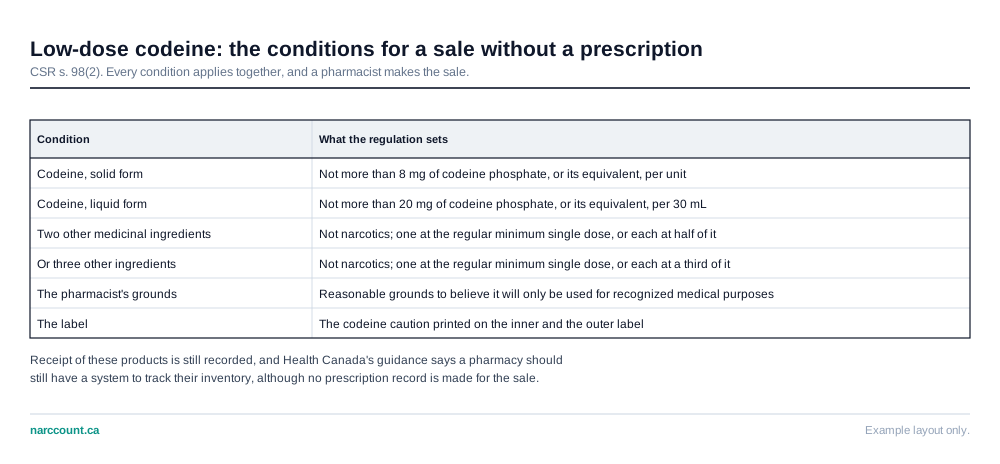
- In solid form it contains not more than 8 mg of codeine phosphate, or its equivalent, per unit; in liquid form, not more than 20 mg per 30 mL.
- It also contains two other medicinal ingredients that are not narcotics, with one at no less than the regular minimum single dose or each at no less than half of it; or three such ingredients, with one at no less than the regular minimum single dose or each at no less than a third of it.
- The pharmacist has reasonable grounds to believe it will only be used for recognized medical purposes.
- The caution “This product contains codeine and should not be administered to children except on the advice of a physician, dentist or nurse practitioner”, or its equivalent, is printed conspicuously and legibly on the inner and outer label.
The conditions in one table
The table restates the conditions as the regulation writes them. A product that misses any one of them is outside the exception, and the ordinary prescription rules apply to it.
Who sells it, and the judgement involved
Only a pharmacist sells or provides a low-dose codeine product; Health Canada's guidance lists it as a pharmacist-only activity. The pharmacist decides whether there are reasonable grounds to believe the product will only be used for recognized medical purposes, which the guidance describes as professional judgement about whether a patient's request to self-medicate for a recognized medical or dental reason is appropriate. Some provinces add their own rules for these products, and a pharmacy confirms them with its regulator.
Records: what changes, and what does not
Because the sale needs no prescription, the federal record-keeping for a sale to an individual on a prescription does not apply to it, as Health Canada's guidance confirms. Receipt is different. The guidance says the receipt of any controlled substance, low-dose codeine products included, is documented when it comes from a licensed dealer, another pharmacist or a hospital, with the same details as any other receipt: who received it, the supplier, the date it arrived, and the product, form, strength, quantity and DIN (Controlled Substances Regulations s. 111). The guidance adds that pharmacists should still have a system in place to track inventory for these products.
Why they cause count variances
A perpetual inventory works out the expected quantity from what came in, minus what went out. For a low-dose codeine product, receipts are recorded, but over-the-counter sales can be rung through the front till without ever reaching the dispensing records. The expected figure then still includes every unit that was sold, and the physical count comes up short by exactly the quantity sold over the counter. Take a product received as two cases of 100 tablets, with 120 sold at the counter and 20 dispensed on prescriptions: the records expect 180 on the shelf and the count finds 60. That gap is explained by sales, but until those sales are in the records it reads exactly like a loss.
Where NarcCount fits
NarcCount reconciles the records a pharmacy imports, so it sees a low-dose codeine product's receipts in the purchase records and its prescription dispenses in the dispensing records, but not counter sales that reached neither. Because a prescription number is optional on a NarcCount dispensing row, counter sales can be imported there too. Without them, each count shows the gap described above and the pharmacist explains it on the count. Health Canada's guidance treats a shortage that cannot be reconciled or definitively explained as a loss or theft, so the written explanation is what keeps the two apart.
Sources
Show the 4 sourcesHide the sources
- Controlled Substances Regulations (SOR/2025-242) s. 98 — sale to an individual, and the low-dose codeine exception — Subsection (2): a pharmacist may sell or provide, without a prescription, a finished product containing codeine phosphate if it contains “not more than 8 mg or its equivalent of codeine phosphate per unit” (solid) or “not more than 20 mg or its equivalent of codeine phosphate per 30 mL” (liquid), with the additional medicinal ingredients, the reasonable grounds and the label caution the subsection sets.
- Controlled Substances Regulations (SOR/2025-242) s. 111 — the record of a receipt — Applies to every controlled substance received, other than a patient return.
- Health Canada — Controlled substances guidance for community pharmacists and pharmacy technicians (CS-GD-022), September 29, 2026 — Page 4: “A pharmacist or pharmacy technician must document the receipt of any controlled substance, including low-dose codeine products”. Page 21: “the record-keeping requirements for the sales to individuals do not apply, however pharmacists should still have a system in place to track inventory for these products.”
- Controlled Substances Regulations (SOR/2025-242) s. 239 — in force October 1, 2026 — In full: the regulations “come into force on October 1, 2026.” The Justice Laws copy is a consolidation current to an earlier date, so it may still print “not in force” above each section.
Primary sources for the figures on this page. Regulations change; confirm the current requirement with the source before you rely on it.
More resources
NarcCount does the reconciliation math for you and flags every variance. Get started or read the worked reconciliation example.
General information, not legal or professional advice. For authoritative requirements, refer to the Ontario College of Pharmacists and Health Canada.