
Prescriber Verification and Forged Prescriptions: Pharmacy Rules
Published October 6, 2026
How a pharmacy confirms the prescriber behind a controlled-substance prescription, and when a forged prescription becomes a report to Health Canada.
A forged prescription is one of the ways a controlled substance leaves a pharmacy with no legitimate patient behind it, and Health Canada counts one that was filled as a theft. The Controlled Substances Regulations, in force since October 1, 2026, put the first check on whoever receives the prescription. Health Canada's guidance for community pharmacies (CS-GD-022) then describes how much checking is enough, and when a forgery becomes a loss or theft report. This page covers both.
Whose check it is
A pharmacist or a pharmacy technician who receives an order or prescription for a controlled substance verifies the person's name, title if applicable, and signature if it is not already known to them (Controlled Substances Regulations s. 103). For a prescription, Health Canada's guidance makes them responsible for verifying the identity of the practitioner who issued it, whether it arrived in writing or by phone. Only a pharmacist then sells or provides the controlled substance, and the guidance makes it the pharmacist's responsibility to be satisfied the sale is for a legitimate purpose.
Two or more checks, not public information alone
Health Canada's guidance recommends a robust system that does not rely solely on information readily available to the general public, and a layered approach using two or more verification methods. Its examples:
- Review the prescription's transmission information when it was sent electronically.
- Call back on a clinic telephone number already known to the pharmacy.
- Confirm with the provincial or territorial regulator that the practitioner is in good standing.
- Compare against practitioner credentials established on earlier prescriptions.
- Cross-reference provincial licensing databases with contact information from independent sources.
Electronic prescriptions and orders
Health Canada accepts electronic orders and prescriptions when the digital or electronic signature can be authenticated. At its October 5, 2026 webinar for community pharmacies, Health Canada described the review in the terms of a forgery check: is the prescriber a practitioner under the Controlled Drugs and Substances Act, is there a restriction on their licence that affects prescribing controlled substances, and does all of the information on the prescription line up.
Checking the prescriber, method by method
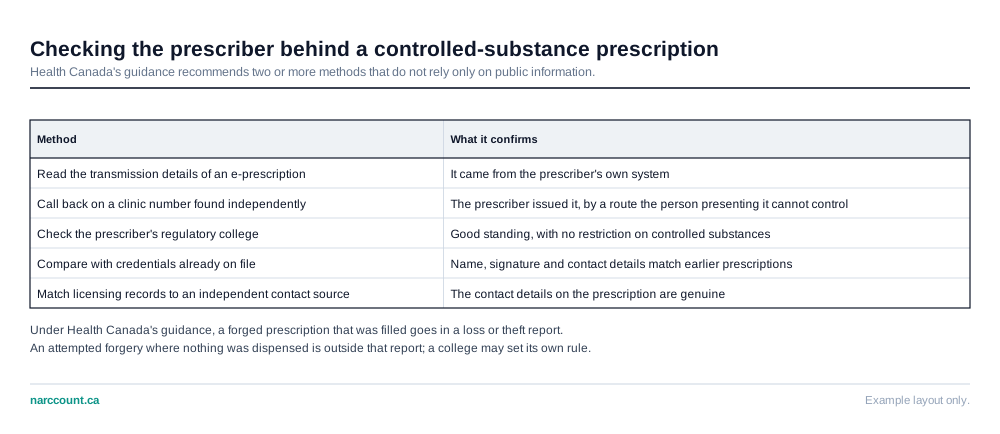
The table pairs each method in Health Canada's guidance with what it confirms. Each covers a different gap, which is why the guidance recommends combining two or more.
When a forgery becomes a report
Health Canada's guidance draws the line at dispensing. When a forged prescription has been dispensed, the pharmacist submits a loss or theft report, and Health Canada's reporting guidance classes it as a theft. The pharmacist reports it to Health Canada in writing within 10 days after becoming aware of it (Controlled Substances Regulations s. 109(2)). Health Canada's guidance says an attempted forgery where no controlled substance was dispensed does not need to be reported to Health Canada, though the provincial or territorial regulator may have its own requirements.
Where NarcCount fits
A forgery that was dispensed leaves the pharmacy as a recorded dispense, so it does not appear as a count variance; the pharmacy's investigation notes and the loss or theft report are what document it. NarcCount does not verify prescriptions or prescribers. It reconciles the records a pharmacy imports, which is where a pattern of unexplained shortages, the other route by which diversion shows itself, becomes visible.
Sources
Show the 5 sourcesHide the sources
- Controlled Substances Regulations (SOR/2025-242) s. 103 — verification of identity — “A pharmacist or pharmacy technician who receives an order or prescription from a person for a controlled substance must verify the person's name and, if applicable, their title as well as their signature if it is not known to the pharmacist.”
- Health Canada — Controlled substances guidance for community pharmacists and pharmacy technicians (CS-GD-022), September 29, 2026 — Page 5: “Pharmacists and pharmacy technicians should have a robust system in place to authenticate the identity of the practitioner who issued the written or verbal prescription, where the system does not solely rely on information readily available to the general public. It is recommended to have a layered approach to authenticate identity, which includes two or more verification methods.” Page 29: “Pharmacists must submit a loss or theft report form when a forged prescription is dispensed.”
- Health Canada — CS-GD-005 Appendix A, types of incidents — A forged prescription that was filled is classed as a theft, which is reportable.
- Controlled Substances Regulations (SOR/2025-242) s. 109 — loss or theft — Federal, verbatim: “the pharmacist must provide a written report to the Minister within 10 days after the day on which they become aware of the loss or theft or are notified.”
- Controlled Substances Regulations (SOR/2025-242) s. 239 — in force October 1, 2026 — In full: the regulations “come into force on October 1, 2026.” The Justice Laws copy is a consolidation current to an earlier date, so it may still print “not in force” above each section.
Primary sources for the figures on this page. Regulations change; confirm the current requirement with the source before you rely on it.
More resources
NarcCount does the reconciliation math for you and flags every variance. Get started or read the worked reconciliation example.
General information, not legal or professional advice. For authoritative requirements, refer to the Ontario College of Pharmacists and Health Canada.