
Central Fill of Controlled Substances in Canadian Pharmacies
Published October 6, 2026
A pharmacy can now central fill another pharmacy's controlled-substance prescriptions without a dealer's licence. The conditions, the order and Ontario's policy.
Until October 1, 2026, a pharmacy that prepared controlled substances for another pharmacy needed a controlled substances dealer's licence from Health Canada. The Controlled Substances Regulations removed that requirement for one specific case: a pharmacist may sell or provide a controlled substance to another pharmacist to fulfil a prescription received at the other pharmacist's pharmacy (Controlled Substances Regulations s. 93(2)). That is what makes central fill possible for narcotics, controlled drugs and targeted substances, compounded products included. The authority is narrow, and the records are kept at both ends. This page covers the conditions, the written order, Ontario's own policy, the two other routes between pharmacists, and what still needs a dealer's licence.
The four conditions
Health Canada's guidance and its October 5, 2026 webinar for community pharmacies describe the same four conditions:
- A prescription already exists. The sale happens only under an existing prescription at the receiving pharmacy, never in anticipation of one.
- The quantity matches. The amount supplied is the amount on that prescription.
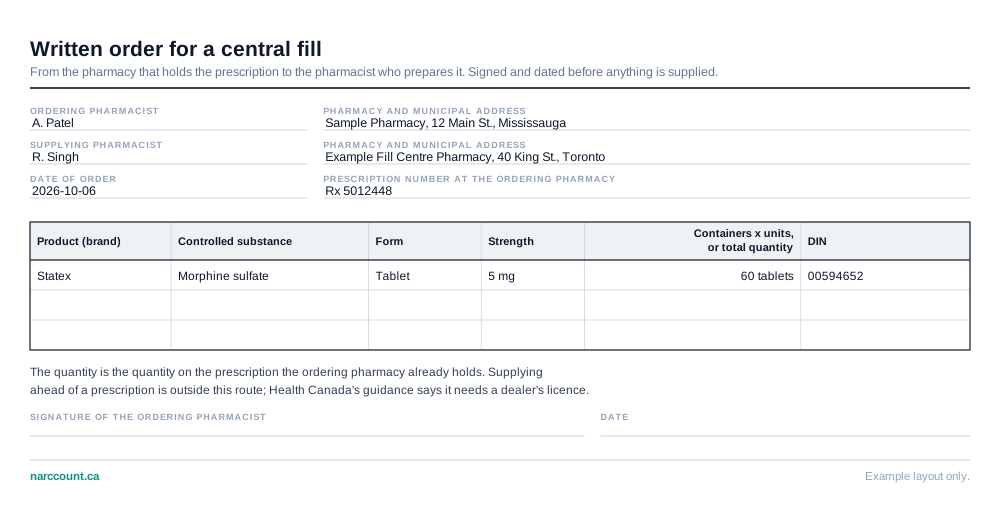
- There is a signed, dated written order. A verbal order is accepted for an emergency supply, not for central fill.
- The order carries the number the ordering pharmacy assigned to the prescription, so the two pharmacies' records can be matched to each other.
What the written order contains
The Controlled Substances Regulations list the contents: the ordering pharmacist's name and the name and municipal address of their pharmacy; the supplying pharmacist's name and the name and municipal address of the place where the sale is made; the number assigned to the prescription; the date; and the product's name or brand name, the controlled substance it contains, its form, strength, number of containers and units per container, and its DIN (s. 93(2)). Health Canada accepts a total quantity, such as a number of tablets or millilitres, where containers and units do not fit the product, and a compounded product, having no brand name, is named by the controlled substance it contains. Before supplying, Health Canada's guidance has the pharmacist confirm the other pharmacist is in good standing with no licence restriction on controlled substances.
Records at both pharmacies
Each side records its half. The supplying pharmacist records the sale: their own name, the ordering pharmacist and their municipal address, the date, and the product (Controlled Substances Regulations s. 112). The ordering pharmacy records the receipt like any other shipment, with the date it arrived, and then the dispense to the patient under its own prescription number (Controlled Substances Regulations ss. 111 and 113). Health Canada's reconciliation steps count stock transferred from another pharmacy, central fill included, as stock received. Federally, the documents are kept at least two years (Controlled Substances Regulations s. 123(1)).
Ontario adds its own central fill policy
In Ontario, central fill is also governed by the Ontario College of Pharmacists' Centralized Prescription Processing (Central Fill) Policy, published October 1, 2026. The central fill pharmacy has the same owner as the originating pharmacy, or a legally binding contract with it, signed by the owner and the Designated Manager of both pharmacies. In Ontario, the owner or Designated Manager notifies the College within 7 days of entering the agreement, using the Central Fill Notification Form. The label shows that the medication was prepared and packaged by a central fill pharmacy, the date it was prepared and packaged, and the number used to cross-reference it at the central fill pharmacy. In Ontario, the policy keeps all records at the central fill pharmacy for at least 10 years.
The two other routes between pharmacists
- Emergency supply. A pharmacist may supply another pharmacist in an emergency, such as a critical stock shortage, an urgent public health need or an order that needed immediate action, on a written or verbal order that declares the emergency (Controlled Substances Regulations s. 93(1)). Health Canada says it is not a routine inventory practice, and the amount is what an existing prescription needs.
- A pharmacy ceasing operations. When a pharmacy closes, or its ownership changes while the location stays the same, its pharmacist may sell the controlled-substance inventory to another pharmacist (Controlled Substances Regulations s. 93(2)). Health Canada's guidance has both pharmacists sign a record of transfer and complete an inventory of what moves. Health Canada no longer receives a notice of the closure or of the transfer, though provincial rules may still apply.
When a dealer's licence is still needed
Supply outside a prescription still needs a controlled substances dealer's licence. A pharmacy that wants to prepare stock for other pharmacies ahead of prescriptions, or supply them regularly outside a prescription, obtains one first. A licence carries a different set of obligations: Health Canada's guidance lists monthly activity reports, suspicious transaction reports, a qualified person in charge, the federal security directive, and Health Canada's prior approval before a destruction. Where one business runs both a pharmacy and a licensed dealer, the guidance keeps the two apart: pharmacy inventory and records are separate from the dealer's, and pharmacy stock is not stored in the dealer's safes or automated dispensing equipment.
Where NarcCount fits
For the ordering pharmacy, a central fill supply is stock received, and it belongs in the purchase records NarcCount reconciles from, dated the day it arrived. For the supplying pharmacy it is stock out, and unless it appears in the records NarcCount reconciles from, the next count there reads short by exactly that quantity. Recorded at both ends, each pharmacy's expected on-hand figure matches its own shelf.
Sources
Show the 5 sourcesHide the sources
- Controlled Substances Regulations (SOR/2025-242) s. 93 — sale to another pharmacist — Subsection (2): a pharmacist may, other than in an emergency, sell or provide a controlled substance to another pharmacist “for the purpose of fulfilling a prescription received at the pharmacy where the other pharmacist practises or if the pharmacy where they practise is ceasing its operations”, on a signed and dated written order that includes “the number assigned to the prescription, if applicable”. Subsection (1) is the emergency route, on a written or verbal order.
- Controlled Substances Regulations (SOR/2025-242) s. 112 — the supplying pharmacist's record — A pharmacist who sells or provides a controlled substance to a person other than an individual records their name, the person's name and municipal address, the date and the product.
- Health Canada — Controlled substances guidance for community pharmacists and pharmacy technicians (CS-GD-022), September 29, 2026 — Page 7: “Prior to October 1, 2026, central fill pharmacies were required to hold a dealer's licence ... This sale or provision can only occur pursuant to an existing prescription at the receiving pharmacy. The amount of controlled substance being sold or provided must match the amount on the prescription at the receiving pharmacy.” Table 1 compares a pharmacist's obligations with a licensed dealer's.
- Ontario College of Pharmacists — Centralized Prescription Processing (Central Fill) Policy, version 2.2, October 1, 2026 — Ontario: same ownership or “a legally binding contract”, signed “by the owner and Designated Manager of both” pharmacies; notice to the College “within 7 days upon entering into an agreement using the Central Fill Notification Form”; records “maintained for a minimum of ten years at the central fill pharmacy”.
- Controlled Substances Regulations (SOR/2025-242) s. 239 — in force October 1, 2026 — In full: the regulations “come into force on October 1, 2026.” The Justice Laws copy is a consolidation current to an earlier date, so it may still print “not in force” above each section.
Primary sources for the figures on this page. Regulations change; confirm the current requirement with the source before you rely on it.
More resources
NarcCount does the reconciliation math for you and flags every variance. Get started or read the worked reconciliation example.
General information, not legal or professional advice. For authoritative requirements, refer to the Ontario College of Pharmacists and Health Canada.