
Controlled Substance Prescription Transfers and Extensions
Published October 6, 2026
A controlled-substance prescription can be transferred any number of times and extended, inside one window that starts when the first pharmacy received it.
Transfers and extensions of controlled-substance prescriptions used to rest on a temporary Health Canada class exemption. Since October 1, 2026 they are written into the Controlled Substances Regulations, with one window for both, measured from the day the first pharmacy received the prescription. Inside that window there is no limit on how many times a prescription is transferred, and a pharmacist may extend it, adjust it or, where the province allows, substitute it. This page covers each change, what both pharmacies record, and the transition for prescriptions received before October 1.
Transfers: unlimited, inside the window
A pharmacist or pharmacy technician may transfer a prescription to another pharmacist or pharmacy technician within two years after the day the prescription was received (Controlled Substances Regulations s. 102). The regulation limits the period, not the number of transfers. Health Canada counts the period from the day the first pharmacy received the original prescription, and also accepts counting from the date the prescriber issued it. The transferring side sends the written prescription, or for a verbal one a copy of the document it was recorded on; Health Canada's guidance also accepts detailed information from the original, such as its number, the drug and quantity, and the date issued. Any extension or substitution made before the transfer goes with it, and the transferring pharmacy then inactivates its own copy so that it cannot be filled or transferred again.
Extensions: a pharmacist's decision, in writing
A pharmacist may extend a prescription if the new expiry date is no later than two years after the day the pharmacist received it (Controlled Substances Regulations s. 101). Health Canada's guidance spells out the practice. The extension is a pharmacist's act, never a technician's. It needs provincial authority: the guidance says the pharmacist must be authorized by provincial or territorial legislation and scope of practice. It cannot be given verbally, and the pharmacist keeps a written record of it. It can be repeated, as long as the outer limit of the window is not passed. For a transferred prescription the window still runs from the day the first pharmacy received the original, which is why the receiving pharmacy notes that date. In Ontario, the Ontario College of Pharmacists says pharmacists and interns can extend, which it also calls renew, or adapt a controlled-substance prescription within two years of the date of receipt.
Adjustments inside the original quantity
Health Canada's guidance confirms four changes a pharmacist may make where the province permits them, as long as the quantity dispensed does not exceed what the prescriber originally authorized:
- Formulation: a different dosage form, such as a liquid in place of a tablet.
- Dose and regimen: for example, half the daily dose taken for twice as long.
- De-prescribing: a planned, supervised reduction or stop.
- Part-filling: dispensing less than the prescribed amount, including during a shortage or at the patient's request.
Substitution, and why Ontario is different
The Controlled Substances Regulations let a pharmacist substitute one controlled substance for another identified in a prescription, before the sale or compounding, but only if the pharmacist is authorized to do so under the laws of the province (s. 100). Health Canada expects the substitute to be therapeutically equivalent and not to run past the prescribed duration of treatment, and a substitution covers only the refills that remain. It never turns a prescription for a drug that is not controlled into one for a controlled substance. The pharmacist records their name, the original prescription number, the date, the substance prescribed and the one substituted (Controlled Substances Regulations s. 115). In Ontario, the Ontario College of Pharmacists says pharmacists cannot therapeutically substitute one controlled substance for another, because that authority is not in provincial legislation.
What both pharmacies record on a transfer
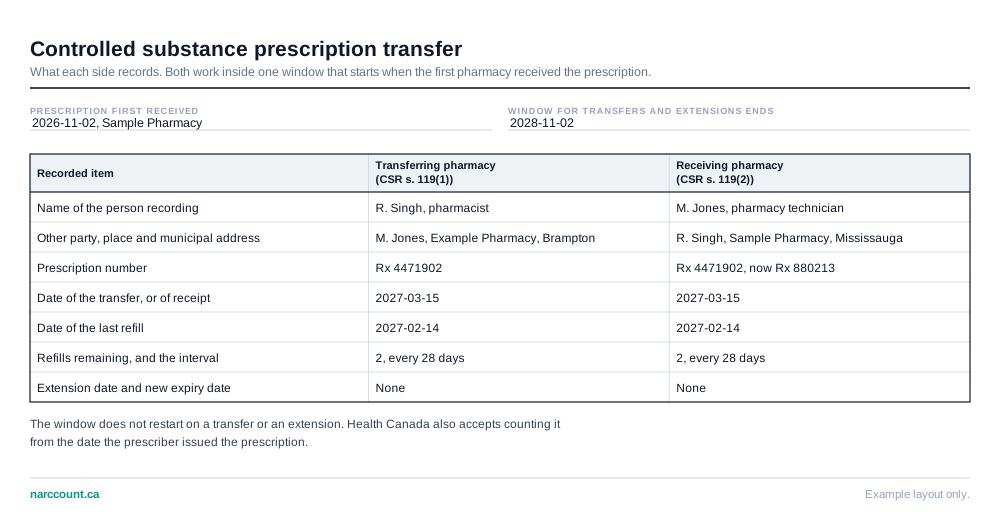
The transferring side records its own name; the other pharmacist or technician with the name and municipal address of their pharmacy; the prescription number; the date of the transfer; the date of the last refill with any refills remaining and their interval; and any extension with its new expiry date (Controlled Substances Regulations s. 119(1)). The receiving side records the same from its end, including the date it received the transfer (Controlled Substances Regulations s. 119(2)), and Health Canada's guidance adds both the transferring pharmacy's prescription number and the new one the receiving pharmacy assigns.
Prescriptions received before October 1, 2026
Before October 1, extensions and transfers were authorized by a subsection 56(1) class exemption, which the regulation replaced. To keep care continuous, Health Canada's guidance allows a prescription received before October 1, 2026 to be extended or transferred until October 1, 2028, whatever the date it was first received, subject to provincial requirements. Health Canada's October 5, 2026 webinar gave the matching example: a prescription received on October 1, 2026 may be extended, substituted and transferred, but cannot be used after October 1, 2028.
Where NarcCount fits
A transfer moves a prescription, not stock, so it changes neither pharmacy's controlled-substance inventory until a fill is dispensed. NarcCount reconciles from the dispensing records each pharmacy imports, so a refill under a transferred prescription appears at the pharmacy that dispensed it, under its own prescription number, and each pharmacy's count stands on its own records.
Sources
Show the 7 sourcesHide the sources
- Controlled Substances Regulations (SOR/2025-242) s. 102 — transfer of a prescription — Federal, verbatim: “A pharmacist or pharmacy technician may transfer a prescription to another pharmacist or pharmacy technician if (a) they transfer it within two years after the day on which the prescription was received” and provide the written prescription or a copy of the record of a verbal one.
- Controlled Substances Regulations (SOR/2025-242) s. 101 — extension of a prescription — “A pharmacist may extend a prescription if the new expiration date of the extended prescription is not later than two years after the day on which the pharmacist received the prescription.”
- Controlled Substances Regulations (SOR/2025-242) s. 100 — substitution — Substitution only “if the pharmacist is authorized to do so under the laws of the province where the sale, provision or compounding takes place.”
- Controlled Substances Regulations (SOR/2025-242) s. 119 — the records of a transfer — Subsection (1) lists what the transferring pharmacist or technician records; subsection (2) what the receiving one records.
- Health Canada — Controlled substances guidance for community pharmacists and pharmacy technicians (CS-GD-022), September 29, 2026 — Page 18: “Health Canada will allow prescriptions received prior to October 1, 2026 to be extended or transferred until October 1, 2028, regardless of the date on which they were received at the pharmacy, subject to any applicable provincial or territorial requirements.” Page 19: “The regulations do not limit the number of times a prescription can be transferred, but rather the time period”.
- Ontario College of Pharmacists — Controlled Substances Regulations information hub — Ontario, page updated October 2, 2026: pharmacists and interns can “Extend (renew) or adapt prescriptions for controlled substances”, and “Ontario pharmacists cannot therapeutically substitute one controlled substance for another because this authority is not included in provincial legislation”.
- Controlled Substances Regulations (SOR/2025-242) s. 239 — in force October 1, 2026 — In full: the regulations “come into force on October 1, 2026.” The Justice Laws copy is a consolidation current to an earlier date, so it may still print “not in force” above each section.
Primary sources for the figures on this page. Regulations change; confirm the current requirement with the source before you rely on it.
More resources
NarcCount does the reconciliation math for you and flags every variance. Get started or read the worked reconciliation example.
General information, not legal or professional advice. For authoritative requirements, refer to the Ontario College of Pharmacists and Health Canada.