
Pharmacy Delivery of Controlled Substances: Rules and Records
Published October 6, 2026
A pharmacist or technician can deliver controlled substances by a tracked method to the patient or their designate, never by mail. What the record holds.
Delivering controlled substances to patients is a routine service for many community pharmacies, and the Controlled Substances Regulations, in force since October 1, 2026, set out how it works. A pharmacist or a pharmacy technician may deliver, send or transport a controlled substance (Controlled Substances Regulations s. 106), and Health Canada's guidance confirms they may use an individual or a transport company to do it. Three things follow the package: reasonable security measures, a method that tracks it until the person it is addressed to receives it, and a record at the pharmacy. Health Canada's guidance for community pharmacies (CS-GD-022) adds what that looks like at the door.
Tracked to the person it is addressed to
The pharmacist or technician takes all reasonable measures to keep the substance secure in transit, and uses a method of delivery, sending or transport that tracks it until the consignee receives it (Controlled Substances Regulations s. 107). Health Canada's guidance recommends a carrier able to keep it secure, and a chain of signatures, with the name or employee identifier of everyone who handles it, carrier staff included, up to the final recipient. The responsibility stays with the pharmacist or technician even when a third-party delivery service carries the package, as Health Canada stressed at its October 5, 2026 webinar for community pharmacies.
At the door, and at the counter
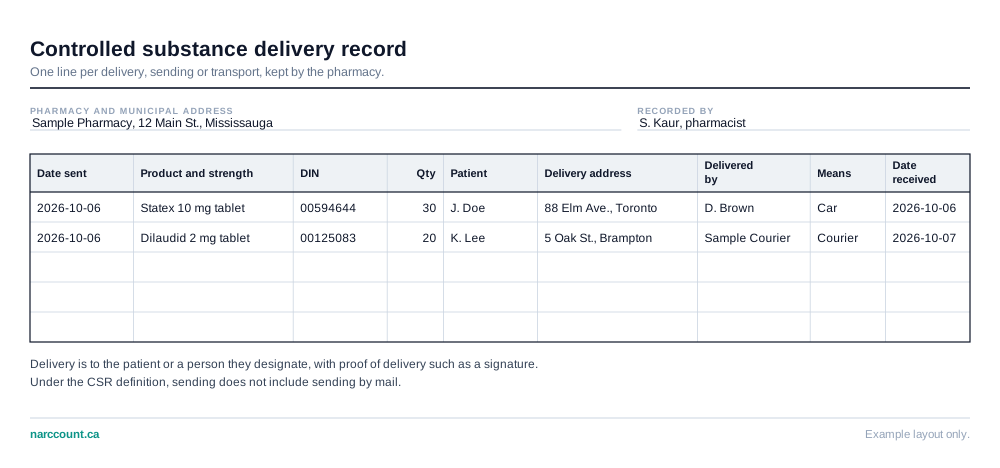
Health Canada's guidance says a controlled substance is delivered to the patient, or to a person the patient designates to accept it, and that proof of delivery such as a signature should be obtained. If nobody is home, the guidance says it should not be left in an unsecured location, such as a doorstep. Pick-up at the counter follows the same idea: the regulation lets a pharmacist provide a controlled substance for the use of another individual (Controlled Substances Regulations s. 98(1)), and Health Canada's guidance gives a spouse, partner or parent collecting for a patient as the example.
Never by mail
In the Controlled Substances Regulations, the defined word send does not include sending by mail (s. 1(1)). A pharmacy sending a controlled substance therefore does not mail it. Provincial rules on delivery can add to the federal ones, and the pharmacy's regulator is the place to confirm them.
Stock going to a destruction dealer
When controlled substances go to a licensed dealer specialized in destruction, the regulation adds packaging: a container sealed so that it cannot be opened without breaking the seal, and marked in a way sufficient to identify it (Controlled Substances Regulations s. 107). Health Canada's guidance describes the same container as sealed, tamper-evident and carrying a unique identifier.
The delivery record
The person who delivers, sends or transports records their name and the name and municipal address of their pharmacy; the name of any agent who carried it; the name of the person it went to, or the patient's name and any animal's name; the municipal address it went to; the date; the means of transportation; and the product's name or brand name, the controlled substance it contains, form, strength, number of containers and units, and DIN (Controlled Substances Regulations s. 120). Health Canada's guidance asks for two dates: the day it left the pharmacy and the day it was received.
When a delivery goes missing
Health Canada's guidance lists a delivery from the pharmacy straight to a patient among the ways a loss in transit can happen, and its October 5, 2026 webinar put the responsibility on the sender. A driver or courier acting for the pharmacist who learns of a loss or theft tells the pharmacist immediately (Controlled Substances Regulations s. 109(1)), and the pharmacist reports it to Health Canada in writing within 10 days after becoming aware of it (Controlled Substances Regulations s. 109(2)).
Where NarcCount fits
A delivered prescription is a dispense, and it reaches NarcCount through the pharmacy's dispensing records like any other. A package lost after it was dispensed does not appear as a variance on the shelf count, because the dispense already took it out of the expected figure. The delivery record and the pharmacist's loss or theft report are where that loss is documented, which is why the two dates on the delivery record matter.
Sources
Show the 7 sourcesHide the sources
- Controlled Substances Regulations (SOR/2025-242) s. 106 — delivery, sending and transport — “A pharmacist or pharmacy technician may deliver, send or transport a controlled substance.”
- Controlled Substances Regulations (SOR/2025-242) s. 107 — requirements during transportation — Take “all reasonable measures to ensure the security of the controlled substance” and “use a method of delivery, sending or transportation that ensures the tracking of the controlled substance until the consignee receives it”; to a dealer specialized in destruction, a sealed container “marked in a manner sufficient to identify the container”.
- Controlled Substances Regulations (SOR/2025-242) s. 120 — the delivery record — The fields the person who delivers, sends or transports records.
- Controlled Substances Regulations (SOR/2025-242) s. 1 — definitions — “send does not include sending by mail.”
- Health Canada — Controlled substances guidance for community pharmacists and pharmacy technicians (CS-GD-022), September 29, 2026 — Page 27: “Controlled substances must be delivered to the patient or to a person designated to accept the delivery on behalf of that individual. Proof of delivery, such as a signature, should be obtained. For example, if the final recipient is not home, controlled substances should not be left in an unsecured location.” Page 13: the CSR “allow another individual (e.g., spouse, partner, parent) to pick up medication on behalf of a patient or an animal.”
- Controlled Substances Regulations (SOR/2025-242) s. 109 — loss or theft — Federal, verbatim: “the pharmacist must provide a written report to the Minister within 10 days after the day on which they become aware of the loss or theft or are notified.”
- Controlled Substances Regulations (SOR/2025-242) s. 239 — in force October 1, 2026 — In full: the regulations “come into force on October 1, 2026.” The Justice Laws copy is a consolidation current to an earlier date, so it may still print “not in force” above each section.
Primary sources for the figures on this page. Regulations change; confirm the current requirement with the source before you rely on it.
More resources
NarcCount does the reconciliation math for you and flags every variance. Get started or read the worked reconciliation example.
General information, not legal or professional advice. For authoritative requirements, refer to the Ontario College of Pharmacists and Health Canada.