
Destroying Controlled Substances in a Pharmacy: Who Can Witness
Published October 6, 2026
Under the Controlled Substances Regulations a technician can destroy, and the witness can be a technician, intern or other health professional.
The Controlled Substances Regulations changed who may destroy controlled substances in a community pharmacy and who may watch. Since October 1, 2026, a pharmacist or a pharmacy technician may carry out a destruction on site, and the witness may be another pharmacist, technician or intern, a practitioner, or any other health professional (Controlled Substances Regulations s. 110(1)). The repealed targeted-substance rules had limited the witness to a pharmacist or a practitioner. Health Canada has also written the denaturing-container practice into its guidance for community pharmacies (CS-GD-022). This page covers who destroys, who witnesses, how returns and expired stock are handled, and what the record and the joint declaration contain.
Two kinds of stock awaiting destruction
Health Canada's guidance separates them. Post-consumer returns are controlled substances a patient brings back for destruction. A pharmacist or technician may accept them, and keeps them in a collection container in a secure location only authorized staff can reach, marked so that the container can be identified (Controlled Substances Regulations s. 104). Unserviceable stock is the pharmacy's own inventory that has expired or been damaged and cannot be dispensed. Both may be destroyed locally at the pharmacy. The guidance recommends a collection container that is opaque, inconspicuous and tamper-evident once sealed, marked with a unique identifier such as a number, or a number and a date. It also recommends separating the records of inactive inventory, meaning unserviceable stock, expired stock and returns, from those of active inventory.
Who destroys, and who may witness
A destruction in a pharmacy is carried out by a pharmacist or a pharmacy technician (Controlled Substances Regulations s. 110(1)). One witness is enough, and it is another person from this list:
- a pharmacist, pharmacy technician or intern, including one practising in a hospital
- a practitioner, meaning a physician, dentist or veterinarian, or a midwife, nurse practitioner or podiatrist
- any other health professional entitled to practise in the province
The method: altered beyond use
The regulation defines destroying a controlled substance as altering or denaturing it to such an extent that its consumption is rendered impossible or improbable (Controlled Substances Regulations s. 1(1)), by a method that complies with the federal, provincial and municipal environmental protection law where the destruction takes place (s. 110(1)). Health Canada's guidance recommends a change of state, such as from solid to liquid, and points to WHMIS sheets and the provincial regulator for substance-specific methods. It warns that chlorine bleach has been reported to cause exothermic reactions and should be left to licensed dealers with the right equipment. After local destruction, returns may be disposed of in a way that is safe, environmentally responsible and secure, and that protects confidential patient information.
Denaturing containers
Health Canada's guidance allows a container with a built-in denaturing agent. Returns received from patients can go into it as they arrive, without a witness each time something is added. When the container is full, a pharmacist or technician seals it in front of a witness, and both complete the joint declaration. Health Canada's October 5, 2026 webinar for community pharmacies said the same, and added that only a pharmacist may provide controlled substances to a licensed dealer for destruction.
The record and the joint declaration
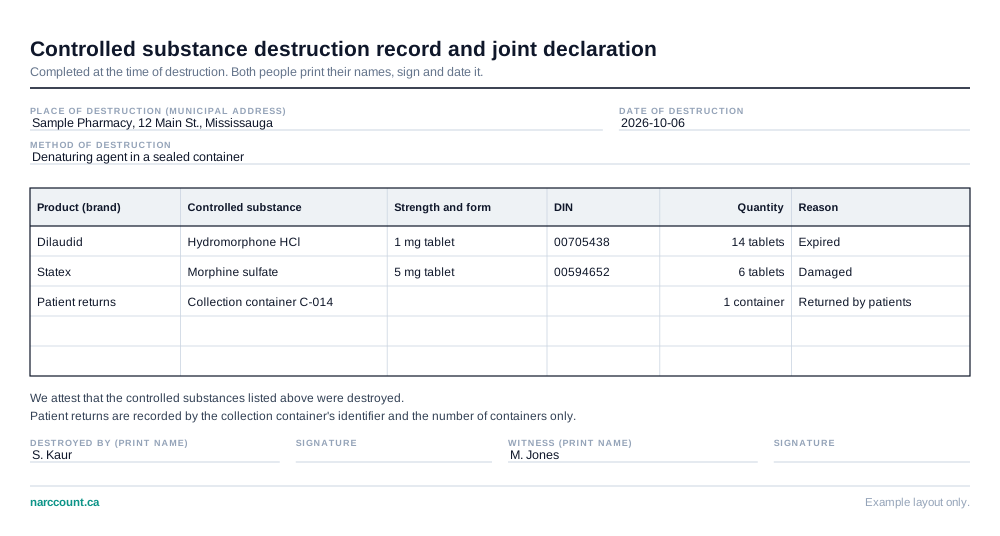
Immediately after the destruction, the person who carried it out and the witness sign and date a joint declaration attesting that the controlled substance was destroyed, each adding their name in printed letters (Controlled Substances Regulations s. 110(1)). The person who destroyed it also records their name, the witness's name, the municipal address of the place, the date, the method, and for each product its name or brand name, the controlled substance it contains, form, strength, number of containers and units, and DIN. For patient returns, only the collection container's identifier and the number of containers are recorded (Controlled Substances Regulations s. 121).
Sending stock to a destruction dealer instead
A pharmacy may instead sell or provide its controlled substances, returns included, to a licensed dealer specialized in destruction, on that dealer's signed and dated written order (Controlled Substances Regulations s. 92(1)). A return the pharmacy did not destroy itself goes to such a dealer (Controlled Substances Regulations s. 110(2)). Health Canada's guidance recommends asking the company for proof of its licence, and allows a third-party service provider to collect returns and pass them to a licensed dealer, while the pharmacist keeps the destruction records rather than relying on the provider for them. The package travels sealed so that it cannot be opened without breaking the seal, marked so it can be identified, by a tracked method (Controlled Substances Regulations s. 107).
Where NarcCount fits
Destroyed stock leaves the perpetual inventory without a dispense, so it needs its own entry. NarcCount imports destruction records alongside purchases and dispensing and subtracts each destroyed quantity from the expected on-hand figure, so a documented destruction explains a reduction instead of appearing as a shortage at the next count. Patient returns were never part of the pharmacy's dispensable stock, which is one reason Health Canada's guidance keeps their records apart from active inventory.
Sources
Show the 6 sourcesHide the sources
- Controlled Substances Regulations (SOR/2025-242) s. 110 — destruction in a pharmacy — “(a) the destruction is witnessed by another person among the following: (i) a pharmacist, pharmacy technician or intern, including one who is practising in a hospital, (ii) a practitioner, or (iii) any other health professional”; and “immediately following the destruction, the person who carried out the destruction and the witness sign and date a joint declaration”.
- Controlled Substances Regulations (SOR/2025-242) s. 121 — the destruction record — For a returned finished product, “only the identifier marked on the collection container of the finished product and the number of collection containers”.
- Controlled Substances Regulations (SOR/2025-242) s. 104 — patient returns — Kept “in a collection container that is in a secure location to which only persons whom the pharmacist or technician has authorized have access and that is marked in a manner that is sufficient to identify the container.”
- Controlled Substances Regulations (SOR/2025-242) s. 1 — definitions — “destroy, in relation to a controlled substance, means to alter or denature it to such an extent that its consumption is rendered impossible or improbable.”
- Health Canada — Controlled substances guidance for community pharmacists and pharmacy technicians (CS-GD-022), September 29, 2026 — Page 30: with a container that has a built-in denaturing agent, “No witnessing is required each time a substance is placed in the container. Once the container is full, the pharmacist or pharmacy technician should seal the container in the presence of a witness, and complete the joint declaration”.
- Controlled Substances Regulations (SOR/2025-242) s. 239 — in force October 1, 2026 — In full: the regulations “come into force on October 1, 2026.” The Justice Laws copy is a consolidation current to an earlier date, so it may still print “not in force” above each section.
Primary sources for the figures on this page. Regulations change; confirm the current requirement with the source before you rely on it.
More resources
NarcCount does the reconciliation math for you and flags every variance. Get started or read the worked reconciliation example.
General information, not legal or professional advice. For authoritative requirements, refer to the Ontario College of Pharmacists and Health Canada.