
Narcotic Destruction Records in a Canadian Pharmacy
Published September 21, 2026
How destruction and waste of narcotics and controlled substances is documented in Canadian pharmacies, how long records are kept, and how it affects reconciliation.
A destruction record is the paper trail for stock that leaves a pharmacy's inventory without being dispensed to a patient. It covers expired product, returned or damaged product, spilled or wasted doses and anything else taken out of the count for disposal. This page covers the Canadian position only. American rules do not apply to a Canadian pharmacy, so nothing here draws on them. The aim is to explain what a useful record contains, how long such records are kept, and how destroyed stock connects to the reconciliation that inspectors look at.
Why destruction has its own record
Expected on-hand is worked out from what came in and what went out. Dispensing is one way out. Destruction is another. If destroyed quantities are missing from the record, the shelf count will fall short of the expected figure and the gap looks exactly like a loss. A separate, dated destruction entry lets a reviewer tell an explained reduction from an unexplained one. That distinction is the main reason destruction records are kept apart from dispensing records rather than folded into adjustments.
A good entry next to a weak one
- Good: the date of destruction, the drug name, strength and form, the quantity destroyed in units, and the reason such as expired, returned, damaged or wasted during preparation.
- Good: the lot number and expiry date where the product has them, and a note of which purchase the stock came from.
- Good: the method or service used, and the names of the people who carried out and witnessed the destruction, each identified in full.
- Good: the balance before and after, so the reduction can be traced into the running count.
- Weak: an entry that says only 'expired stock removed' with no drug, strength, quantity or date.
- Weak: initials with no way to tell who they belong to, or a witness line left blank.
- Weak: a quantity written as 'some' or 'about', or a single line covering several different drugs.
- Weak: an adjustment to the count with no destruction entry behind it.
A typical destruction sequence
Pharmacies generally follow a sequence along these lines, though the exact steps depend on the pharmacy's policies and its college. The product is identified and separated from active stock. It is counted, and the count is compared with the perpetual balance. The destruction is carried out by the pharmacy's chosen method or through a service, with a witness present. The entry is completed at the time, not reconstructed later, and the balance is reduced by the destroyed quantity. Any paperwork from a destruction service is kept with the entry so the two can be matched.
Retention of destruction records
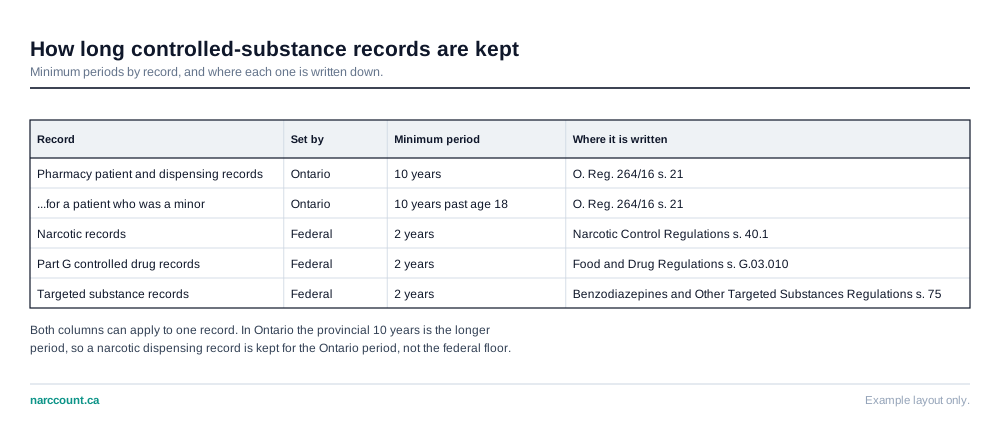
Records of this kind are kept for a fixed minimum time, and the period depends on which rule is being applied. In Ontario, pharmacy patient and dispensing records, which include controlled-substance dispensing, must be kept at least 10 years (O. Reg. 264/16 s. 21). Federally, narcotic and controlled-substance records must be kept at least 2 years (Narcotic Control Regulations s. 40.1; Food and Drug Regulations Part G s. G.03.010; Benzodiazepines and Other Targeted Substances Regulations s. 75). The two figures are not interchangeable, and a pharmacy outside Ontario should confirm the provincial position with its own college.
Destruction, variance and loss
When a count does not match, destruction entries are among the first things checked. Common causes of a variance include a destruction that was carried out but never entered, an entry made against the wrong strength, a quantity transposed while copying, a return that was destroyed without being logged as received, and a partial container counted as whole. A documented destruction explains a reduction. It does not explain a shortage. Federally, a loss or theft of a controlled substance is reported to Health Canada's Office of Controlled Substances within 10 days of discovering it, and that is a separate process from recording a planned destruction. How often the whole inventory is reconciled also varies by province, and the Ontario College of Pharmacists expects it at least twice a year.
Finding a disposal option
This page does not list disposal locations or services, and NarcCount does not provide destruction or take-back. Which service or arrangement a pharmacy uses, and what witnessing it involves, is a matter between that pharmacy and its provincial regulator. The college or Health Canada is the place to ask for current, accurate direction.
How NarcCount handles destruction records
NarcCount is software sold to pharmacies. Pharmacies import their dispensing, purchase and destruction records, and NarcCount calculates expected on-hand from all three, so a destroyed quantity reduces the expected figure rather than appearing as an unexplained gap. Variances are listed for review, and the supporting records are kept together so they can be produced when an inspector asks for them. NarcCount does not dispense, destroy or advise on professional obligations.
More resources
NarcCount does the reconciliation math for you and flags every variance. Get started or read the worked reconciliation example.
General information, not legal or professional advice. For authoritative requirements, refer to the Ontario College of Pharmacists and Health Canada.