
Pharmacy Technicians and Controlled Substances in Canada
Published October 6, 2026
Technicians now receive, compound, transfer, destroy and deliver controlled substances in their own right. Ordering and dispensing stay with pharmacists.
On October 1, 2026, the Controlled Substances Regulations (SOR/2025-242) came into force, and with them a change that reaches almost every community pharmacy: pharmacy technicians now carry out many controlled-substance activities on their own authority, not only as a pharmacist's agent. The regulation names them beside pharmacists for receiving, compounding, transferring prescriptions, destroying stock and returns, witnessing a destruction and delivering. A short list of activities still belongs to the pharmacist alone. This page sets out both lists with the section behind each, the conditions Health Canada attaches in its guidance for community pharmacies (CS-GD-022, September 29, 2026), and what the change means for a pharmacy's records. It is general information, not legal advice, and provincial rules can be stricter.
What a technician may now do in their own right
- Receive a shipment of controlled substances from a licensed dealer, another pharmacist or a hospital, and record the receipt (Controlled Substances Regulations s. 111).
- Receive a written prescription or order, or take a verbal prescription from a practitioner, and record who it came from and when (Controlled Substances Regulations ss. 116 and 117).
- Compound a finished product containing a controlled substance, other than a restricted drug (Controlled Substances Regulations s. 99).
- Transfer a prescription to another pharmacist or pharmacy technician (Controlled Substances Regulations s. 102).
- Accept a controlled substance a patient brings back for destruction, and keep it in a marked collection container in a secure location (Controlled Substances Regulations s. 104).
- Destroy controlled substances on site, or act as the witness when someone else does (Controlled Substances Regulations s. 110(1)).
- Deliver, send or transport a controlled substance by a tracked method (Controlled Substances Regulations ss. 106 and 107).
What stays with the pharmacist
Health Canada's guidance is explicit that these activities cannot be handed to a technician or to anyone else acting for the pharmacist.
- Ordering. Only a pharmacist orders controlled substances from a licensed dealer, a hospital or another pharmacist. A technician can prepare the order, but it is placed in a pharmacist's name and that pharmacist answers for it.
- Selling or providing, which includes dispensing on a prescription and selling a low-dose codeine product without one (Controlled Substances Regulations s. 98).
- Substituting, refilling or extending a prescription (Controlled Substances Regulations ss. 100 and 101).
- Deciding who has access to the secure location where controlled substances are kept (Controlled Substances Regulations s. 105).
- Reporting a loss or theft to Health Canada. A technician who learns of one tells the pharmacist immediately (Controlled Substances Regulations s. 109(1)).
- Making sure the records are kept, which falls to the pharmacist responsible for the pharmacy's operations (Controlled Substances Regulations s. 123(1)).
Who does what, side by side
The table sets each activity against the two roles, with the section that sets it. A pharmacy can hold its standard operating procedures and its software permissions up against it, to check that each task sits with the right person.
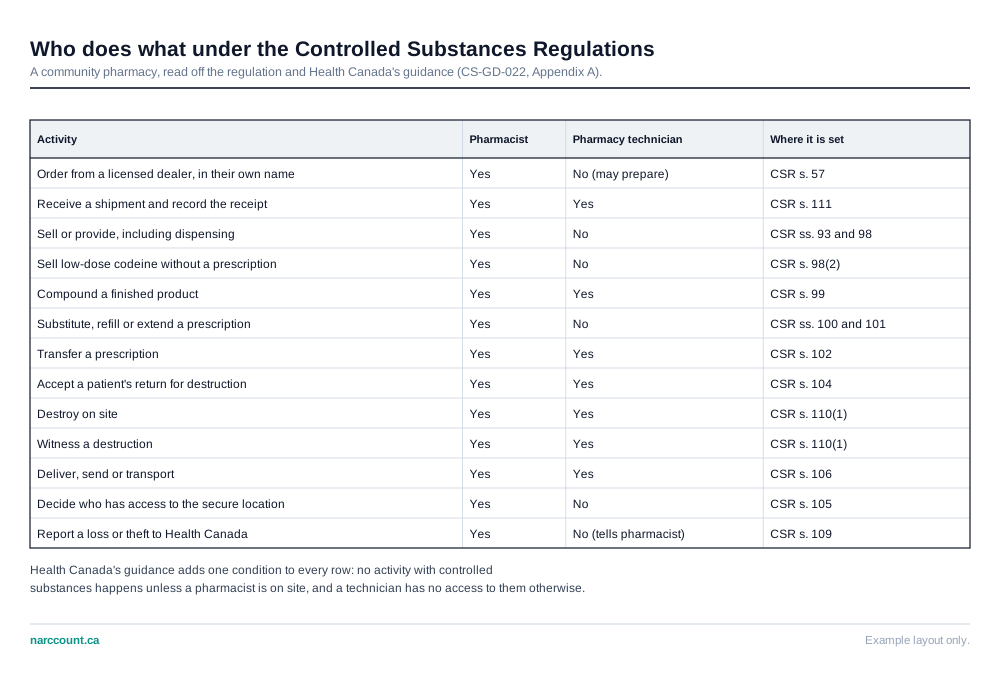
The condition on every row: a pharmacist on site
The new authority is not authority to work alone. Health Canada's guidance says a pharmacist must be on site while any activity with controlled substances is taking place, that a technician must not have access to controlled substances when the pharmacist is absent, and that cleaning or maintenance staff entering an area where controlled substances are stored are supervised by a pharmacist, a duty the guidance says cannot pass to a technician. Health Canada's October 5, 2026 webinar for community pharmacies put it more broadly still: a pharmacist is present whenever anyone else is in the pharmacy, and a technician does not open or close it. The same presentation summed up the change in one line, that a technician cannot do everything a pharmacist can do.
Records a technician now makes in their own name
Because the authority is the technician's own, so is the record. Each recording duty in the regulation names the person who did the work. The person who receives a shipment records their name, the supplier and the date it arrived. The person who transfers a prescription records the other side of the transfer. The person who destroys a controlled substance records the witness, the method and what was destroyed, and the person who delivers records where it went and by what means. The Controlled Substances Regulations also require anyone who records information under them to use a method that allows an audit at any time (s. 122). For a perpetual inventory, that means each receipt, transfer and destruction entry is tied to an identifiable person, not to a shared login or a set of initials nobody can trace.
Provincial scope still decides the details
Provincial rules can narrow what the federal regulation allows. Health Canada's guidance describes technicians acting independently as authorized in the province or territory where they practise, and every pharmacy professional checks with their own regulator. In Ontario, the Ontario College of Pharmacists lists what pharmacy technicians and intern technicians can do under the new regulation: accept verbal prescriptions for controlled substances from a practitioner, receive controlled substances, transfer prescriptions for controlled substances to another pharmacist or technician in Canada, and destroy controlled substances or witness their destruction at the pharmacy.
Where NarcCount fits
NarcCount works out the expected on-hand figure for every drug line from the purchase, dispensing and destruction records a pharmacy imports, and sets it against the physical count. Each count carries the name of the person who counted, and every line that does not balance waits for a note from the pharmacist explaining it. Records entered by a technician feed the same reconciliation as a pharmacist's, which is why the name on each entry matters more now that technicians act in their own right.
Sources
Show the 8 sourcesHide the sources
- Controlled Substances Regulations (SOR/2025-242) s. 111 — what is recorded when a controlled substance is ordered or received — “A pharmacist who orders a controlled substance or a pharmacist or pharmacy technician who receives a controlled substance ... must record” the listed information.
- Controlled Substances Regulations (SOR/2025-242) s. 102 — transfer of a prescription — “A pharmacist or pharmacy technician may transfer a prescription to another pharmacist or pharmacy technician” within the period the section sets.
- Controlled Substances Regulations (SOR/2025-242) s. 110 — destruction in a pharmacy — Destruction “may only be carried out by a pharmacist or pharmacy technician”, witnessed by a pharmacist, pharmacy technician or intern, a practitioner, or any other health professional.
- Controlled Substances Regulations (SOR/2025-242) s. 105 — storage and authorized access — A pharmacist must ensure controlled substances are stored in a secure location and that “only persons whom the pharmacist has authorized have access”.
- Controlled Substances Regulations (SOR/2025-242) s. 122 — an auditable method of recording — “A pharmacist or pharmacy technician who records any information under these Regulations must do so using a method that permits an audit of it to be made at any time.”
- Health Canada — Controlled substances guidance for community pharmacists and pharmacy technicians (CS-GD-022), September 29, 2026 — Appendix A sets out who may conduct each activity. Page 23: “a pharmacist must be present on site while activities with controlled substances are taking place ... a pharmacy technician must not have access to controlled substances in the absence of the pharmacist.” Page 33: “A pharmacist cannot delegate the activity of ordering controlled substances to a pharmacy technician or to an agent/mandatary.”
- Ontario College of Pharmacists — Controlled Substances Regulations information hub — Ontario, page updated October 2, 2026: what pharmacy technicians and intern technicians can do under the new regulation.
- Controlled Substances Regulations (SOR/2025-242) s. 239 — in force October 1, 2026 — In full: the regulations “come into force on October 1, 2026.” The Justice Laws copy is a consolidation current to an earlier date, so it may still print “not in force” above each section.
Primary sources for the figures on this page. Regulations change; confirm the current requirement with the source before you rely on it.
More resources
NarcCount does the reconciliation math for you and flags every variance. Get started or read the worked reconciliation example.
General information, not legal or professional advice. For authoritative requirements, refer to the Ontario College of Pharmacists and Health Canada.