
Ordering and Receiving Controlled Substances in a Pharmacy
Published October 6, 2026
Only a pharmacist orders controlled substances, in their own name. A pharmacist or technician receives them, and the arrival date goes on the record.
Two federal rules frame how controlled substances come into a community pharmacy under the Controlled Substances Regulations, in force since October 1, 2026. The order belongs to a pharmacist. The receipt belongs to whoever opens the box, pharmacist or pharmacy technician, and that person records it. Health Canada's guidance for community pharmacies (CS-GD-022) adds what it expects at the counter: an arrival date on every receipt, a check for tampering on delivery, and contents verified soon enough to tell where anything went missing. This page covers both halves, the record each one produces, and how the date of receipt feeds a reconciliation.
The order is a pharmacist's own
Only a pharmacist orders controlled substances from a licensed dealer, a hospital or another pharmacist. A licensed dealer sells to a pharmacist only on a written order the pharmacist has signed and dated, naming the pharmacist, the place where they practise and the product (Controlled Substances Regulations s. 57(1)). Health Canada accepts an electronic order when the digital or electronic signature can be authenticated. A technician can do the preparation: build the order, check quantities, and line it up against prescription volume. The order itself is placed in the pharmacist's name, and Health Canada's guidance says that pharmacist remains fully accountable for its accuracy, appropriateness and compliance. Ordering is not an activity a pharmacist can delegate to a technician or to any other agent.
Codes, PINs and keys stay personal
Health Canada's guidance asks pharmacists not to share or post ordering codes for controlled substances, PINs or keys. At its October 5, 2026 webinar for community pharmacies, Health Canada said it in plain words: ordering credentials are not shared with other staff, and that includes other pharmacists, and each pharmacist approves and sends an order under their own narcotic code. A shared login on a wholesaler portal, or a code taped inside the dispensary, makes it impossible to say afterwards who placed an order, which is where an inspection or a loss investigation starts. The guidance also recommends ordering quantities in line with prescription volume, so that surplus stock is not sitting where it can be lost or stolen.
The receipt, and what goes on it
A pharmacist or a pharmacy technician may receive a shipment, and the person who receives it records it (Controlled Substances Regulations s. 111). Health Canada's guidance applies this whether the supply came from a licensed dealer, another pharmacist or a hospital in an emergency, and it includes low-dose codeine products, which are sold without a prescription but still arrive as controlled substances. The record carries:
- the name of the person who received it
- the supplier's name, title if any, and municipal address
- the date it was received
- for a finished product, its name or brand name, the controlled substance it contains, its form and strength, the number of containers and units per container, and its DIN
- for anything that is not a finished product, such as methadone powder, its name, form and quantity
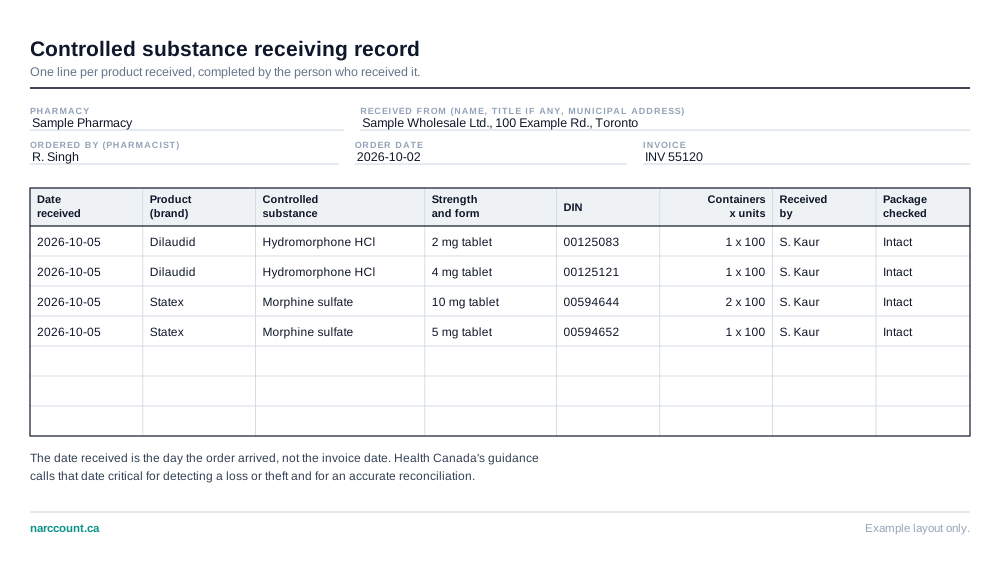
A receiving record, filled in
The example is one delivery of four products, received and checked by a technician. The columns are the fields the regulation names, plus the package check Health Canada's guidance recommends on arrival.
Why the arrival date matters
Health Canada's guidance calls the date of receipt critical for detecting a loss or theft and for an accurate reconciliation, and the reason is arithmetic. An expected on-hand figure is the last count, plus everything received, minus everything dispensed or destroyed since. A shipment invoiced on September 30 that arrived on October 2 belongs after an October 1 count, not before it. Dated by its invoice, it falls in the wrong window: the October 1 count reads short by exactly that shipment, and the next count reads over by the same amount. Both lines then need an investigation that the right date would have avoided.
Checking the box on arrival
Health Canada ties the timing of the check to responsibility. Once a shipment is received it is no longer the sender's, so a delay in opening it widens any investigation from the sender to the pharmacy. The guidance recommends these steps when controlled substances arrive:
- Inspect the package for damage or tampering as soon as it arrives.
- Open it as soon as possible and verify that every item on the order is there.
- If something is missing, first rule out a loss inside the pharmacy.
- If the loss happened before the package arrived, contact the sender, who is responsible for investigating and reporting a loss in transit.
- Note that conversation: the date, who was contacted, and what was missing.
- A sealed bottle holding fewer units than its label is a short-fill, which the guidance treats as a documented inventory adjustment rather than a loss or theft report.
Where NarcCount fits
NarcCount builds each drug's expected on-hand figure from the purchase, dispensing and destruction records a pharmacy imports, and compares it with the physical count. The date on each purchase line decides which reconciliation window the stock falls in, which is why the arrival date, not the invoice date, is the one to import. A shipment dated into the wrong window shows up as a variance on the count, where the pharmacist records what was found. NarcCount does not place orders and holds no ordering credentials.
Sources
Show the 4 sourcesHide the sources
- Controlled Substances Regulations (SOR/2025-242) s. 57 — a licensed dealer's sale to a pharmacist — A licensed dealer sells to a pharmacist only after it “first receives from the pharmacist a written order that is signed and dated” with the listed information.
- Controlled Substances Regulations (SOR/2025-242) s. 111 — the record of an order or a receipt — The record carries the recorder's name, the supplier's name, title and municipal address, “the date of the order or receipt”, and the product's name, form, strength, containers, units and DIN.
- Health Canada — Controlled substances guidance for community pharmacists and pharmacy technicians (CS-GD-022), September 29, 2026 — Page 4: “It is critical to record the date that controlled substances are received at the pharmacy to be able to detect loss or theft and conduct effective inventory reconciliation.” Page 29: on receipt, “Immediately inspect the package for any damage or evidence of tampering” and open it “as soon as possible”. Page 24: “Pharmacists should not share or post ordering codes for controlled substances, PINs, or keys.”
- Controlled Substances Regulations (SOR/2025-242) s. 239 — in force October 1, 2026 — In full: the regulations “come into force on October 1, 2026.” The Justice Laws copy is a consolidation current to an earlier date, so it may still print “not in force” above each section.
Primary sources for the figures on this page. Regulations change; confirm the current requirement with the source before you rely on it.
More resources
NarcCount does the reconciliation math for you and flags every variance. Get started or read the worked reconciliation example.
General information, not legal or professional advice. For authoritative requirements, refer to the Ontario College of Pharmacists and Health Canada.